
What Is rPET? Recycled PET Food Containers Explained
rPET is recycled PET, the clear #1 plastic made partly from used bottles. How it is made, whether it is food safe, what it costs, and the rules.
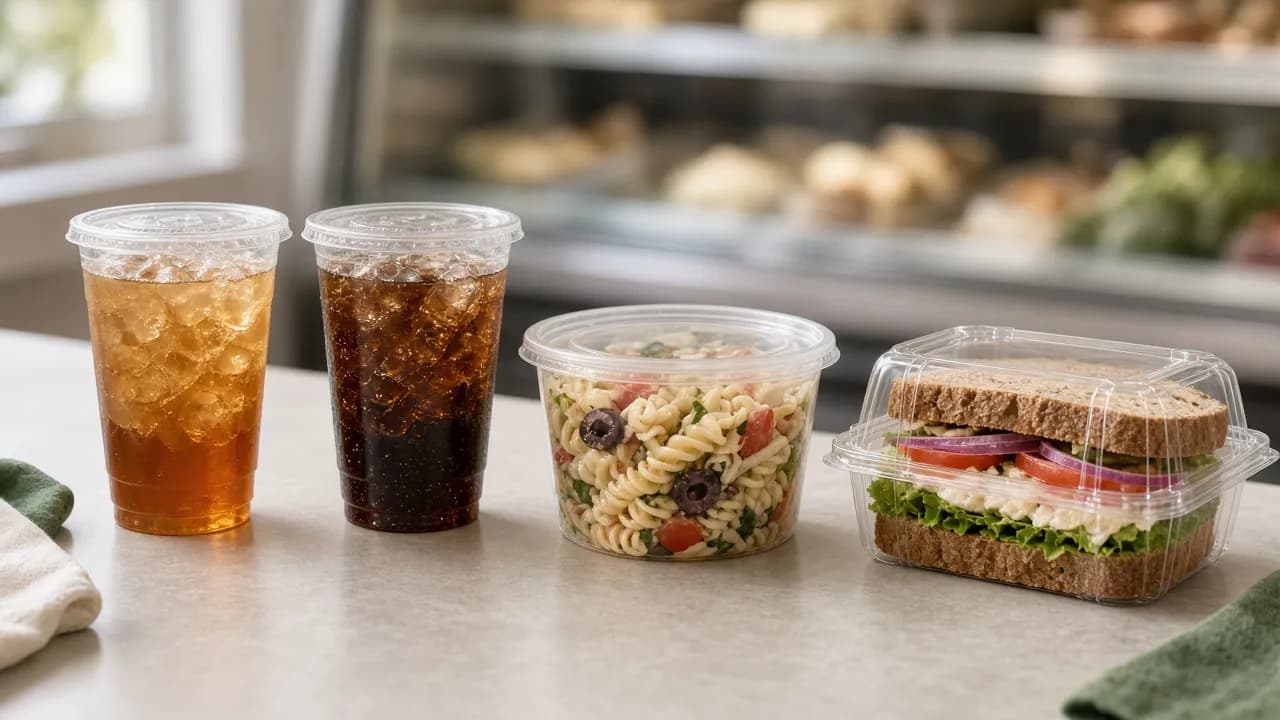
rPET is recycled polyethylene terephthalate, the same clear #1 plastic used in water bottles, cold cups, and deli containers, made partly or fully from PET that has already been used, collected, cleaned, and remelted. In food packaging, an rPET cup looks and works like a new PET cup.
That is the short answer to what is rPET. The price tells a less tidy story. In November 2026, a public wholesale listing put a case of 1,000 Solo 16 oz squat cold cups, made with at least 20 percent post-consumer content, at $154.99. The same maker's plain PET squat cup in the same size listed at $106.49. That is almost 5 cents more per cup, for a cup most customers cannot tell apart.
The recycled content is real. Whether that cup gets recycled again is a different question, and in parts of the Bay Area it is not allowed as foodware at all.
Safra Distribution delivers food packaging on weekly routes from our Fremont warehouse across six Bay Area counties, including clear Planet Choice cups and Planet Choice fiber containers made from bagasse. What follows is what the material is, what it can handle, what it costs, and where the local rules send it.
rPET looks the same as new PET. The difference is where the plastic came from.
Key facts about rPET
- rPET is usually a blend. One 16 oz cold cup listing states at least 20 percent post-consumer content, which leaves up to 80 percent that can be new PET.
- One packaging maker's temperature chart rates PET and rPET together at -20 to 150 F, so rPET is a cold and room-temperature material.
- The FDA reviews recycled plastic for food contact case by case and uses a 0.5 parts per billion dietary concentration as its benchmark for contaminants.
- The EPA put the recycling rate of PET bottles and jars at 29.1 percent in 2018. Most were not recycled.
- California's AB 793 requires plastic beverage bottles to contain at least 25 percent recycled plastic from 2025 and 50 percent from 2030.
- San Mateo County's foodware ordinance does not allow traditional, compostable, or recyclable plastic for most disposable foodware, including cups and clamshells.
Further reading
What does rPET stand for?
The rPET meaning is in the name: recycled polyethylene terephthalate. The lowercase r is the only difference from PET, the clear plastic behind most water bottles and cold cups.
PET carries resin code #1. It is clear, light, and hard to shatter. rPET is the same polymer, and some share of it has already lived one life, usually as a bottle.
A cup sold as rPET does not have to be 100 percent recycled. The maker sets the share.
So the useful question is not whether a cup is rPET. It is how much. Get the percentage in writing before you print a recycled content claim on a menu or a sign.
How is rPET made?
Most rPET is made by mechanical recycling. Used PET is washed, ground, and melted back into resin, and used bottles are a common starting point.
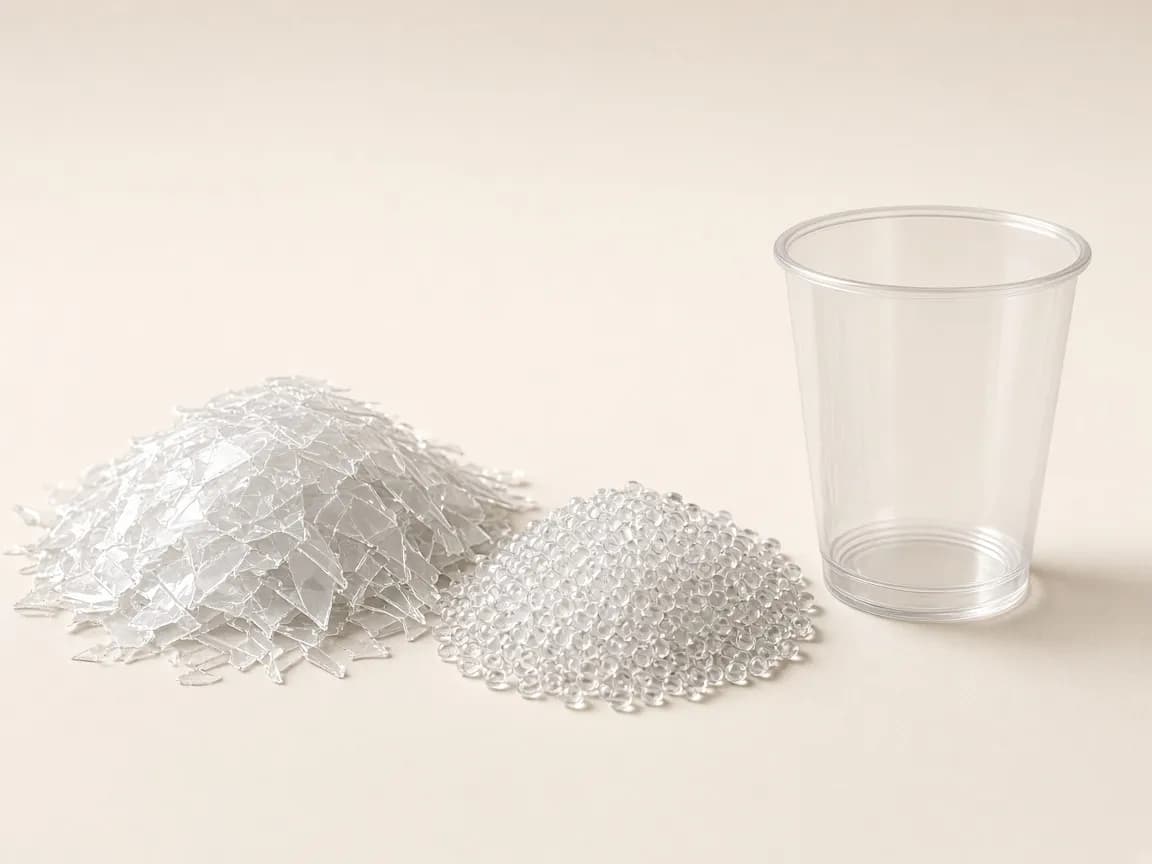
Used PET is washed, flaked, and remelted into rPET pellets.
- Collect. PET bottles and containers come in through curbside programs and California's CRV bottle deposit system.
- Sort. PET is pulled out from other plastics, paper, and metal.
- Wash and flake. Bottles are ground into flakes and washed to strip labels, glue, and residue.
- Decontaminate. For food contact, the flakes go through a cleaning process the recycler has tested to remove contaminants.
- Pelletize. Clean flakes are melted and formed into rPET pellets.
- Form. Pellets are blended with new PET as needed, extruded into sheet, and thermoformed into cups, deli containers, and clamshells.
There is a second route. Chemical recycling, which the FDA calls tertiary recycling, breaks PET down to its building blocks and rebuilds it. The FDA has determined that this route produces recycled PET of suitable purity for food contact, and it no longer reviews those processes one by one.
The weak link is the first step. The EPA put the recycling rate for PET bottles and jars at 29.1 percent in 2018. Clean bottles are a limited supply, and CalRecycle says California's bottle law is meant to increase demand for recycled plastic. Your cup maker buys in that market.
Further reading
What is the difference between rPET and PET?
rPET vs PET comes down to where the plastic came from. The polymer, the heat rating, and the bin are the same.
- Material. Both are polyethylene terephthalate, resin #1.
- Source. PET is made from new resin. rPET contains a stated share of recycled PET.
- Heat. Pactiv Evergreen's chart lists PET and RPET on one line, at -20 to 150 F.
- End of life. Both go in the same bin, and your hauler decides which bin that is.
- Price. In the Solo listings above, the 16 oz rPET squat cup ran about 15 cents each and the PET version about 11 cents.
For the customer holding the cup, there is no difference. The difference is on your invoice and in what you can honestly claim. "Made with 20 percent recycled content" is a claim you can back up. It is not a promise that the cup will be recycled.
Is rPET food safe?
Yes, when it is made through a recycling process the FDA has reviewed for food contact.
The FDA's recycled plastics page names three concerns: contaminants from the used plastic carrying into the new container, plastic not made for food getting mixed in, and additives that are not cleared for food contact. The agency reviews each process case by case, and its benchmark is a dietary concentration of no more than 0.5 parts per billion for a contaminant, which it treats as negligible exposure.
That is a real standard. It is a standard for a process, not a promise about every clear cup on the market.
Ask for the food contact statement on each rPET item before it goes into service. If a supplier cannot produce one, that is your answer.
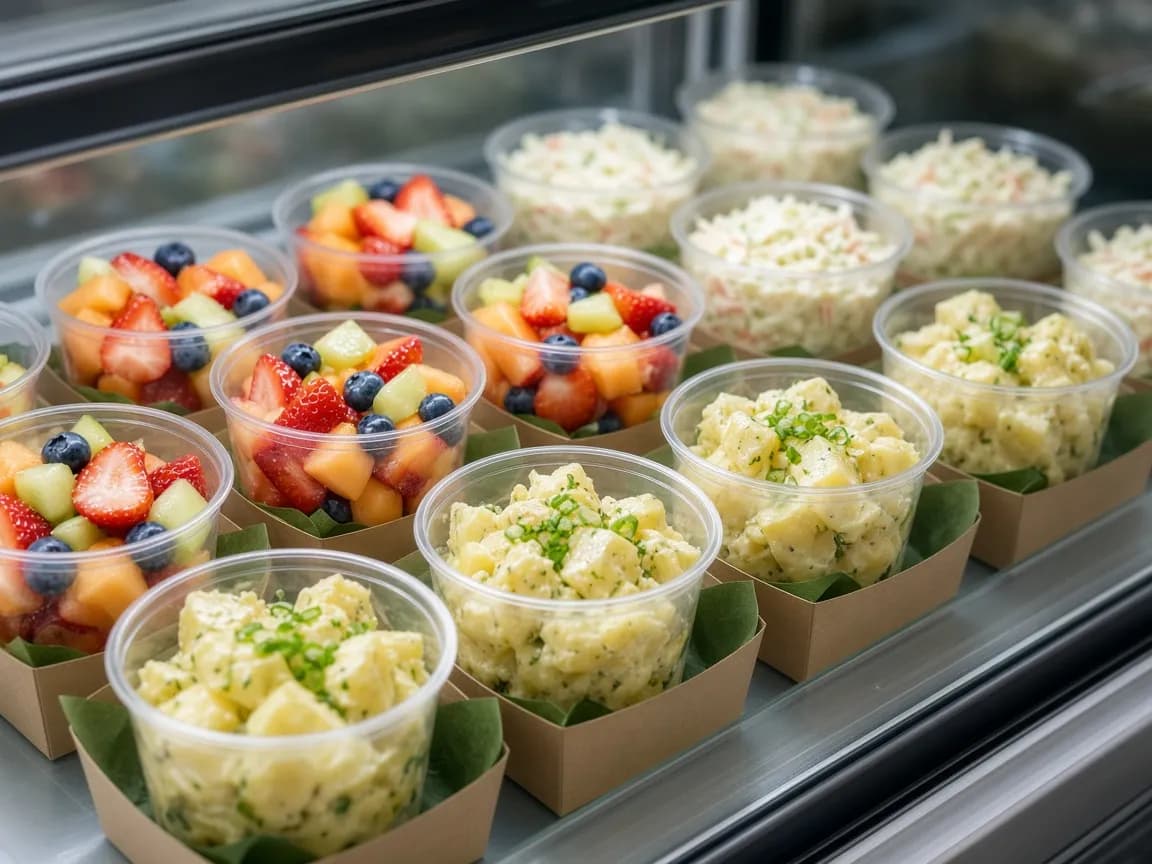
rPET deli containers are made for cold and room-temperature food.
Where is rPET used in food packaging?
rPET shows up wherever clear PET already does.
- Cold cups for iced coffee, iced tea, smoothies, and soda.
- Flat and dome lids for those cups.
- Deli containers for cold sides, salads, and cut fruit.
- Hinged clamshells for salads, sandwiches, and pastries.
- Sushi trays and clear lids, where the top has to show the food. Our sushi trays wholesale guide covers the formats.
- Bottles for water, juice, and soda, where AB 793 sets the recycled content floor.
Clear plastic holds on for one reason. Fiber is opaque. A customer at a grab-and-go case wants to see the pasta salad, and a bagasse clamshell cannot show it. The main clear alternative is PLA, and our PLA guide covers its limits.
Further reading
How hot can rPET get?
rPET is a cold and room-temperature material. Pactiv Evergreen's chart rates PET and rPET at -20 to 150 F.
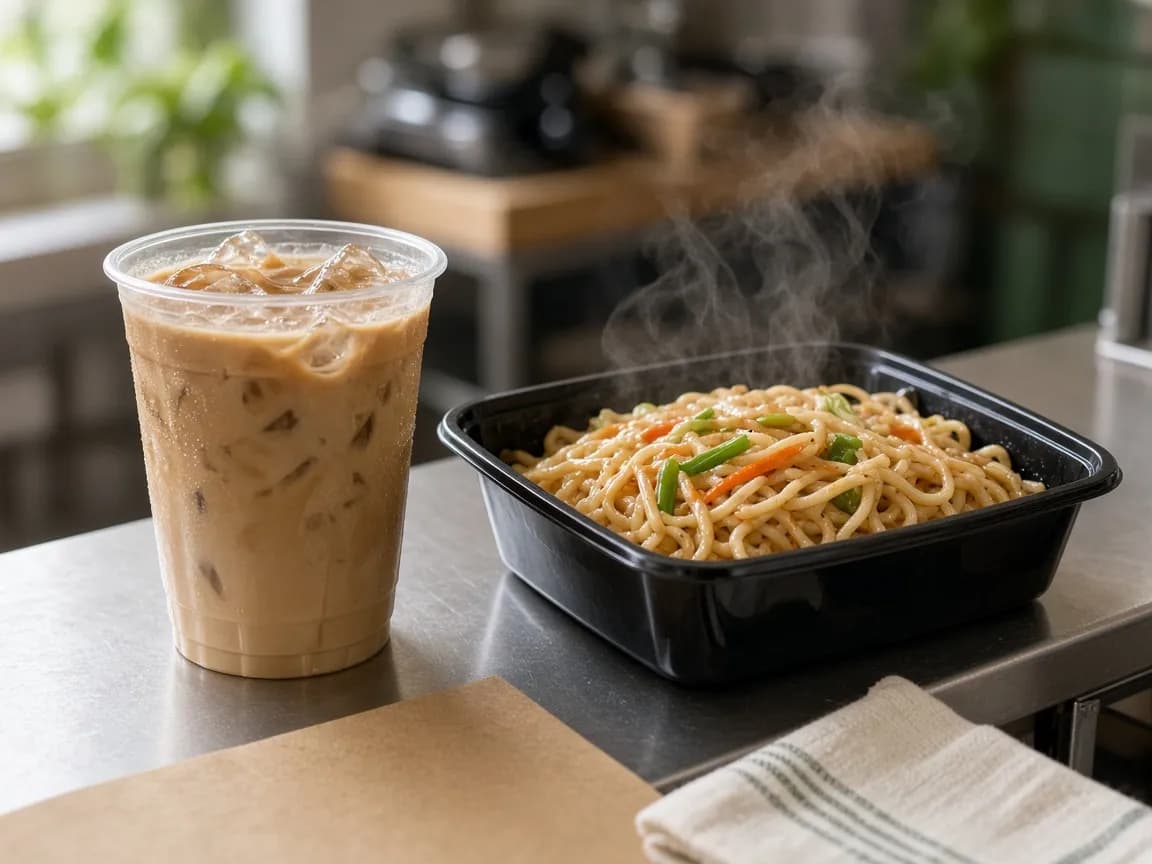
rPET is for cold food. Hot food goes in polypropylene, fiber, or CPET.
The same chart shows where the other materials land:
- PET and rPET. -20 to 150 F.
- Polypropylene (PP). 0 to 212 F.
- CPET. -20 to 400 F. It is crystallized PET, made for ovenable trays.
- Clear PLA. 0 to 105 F.
An iced latte is well inside that range. A soup ladled from the pot is past it before the lid goes on.
rPET does have one honest edge. Clear PLA stops at 105 F on the same chart, so a hot delivery van is less of a risk for a case of rPET cups. That edge ends at the cold menu. For anything hot, use polypropylene, fiber, or CPET, and pick by the hottest item you serve, not the average one.
What rPET sizes are there, and which fits which drink or dish?
rPET cups come in the same sizes as PET cups. Solo's rPET line on one public listing runs 9, 12, 16, 20, and 24 oz.
rPET cups and deli containers in common sizes, matched to the drink or dish.
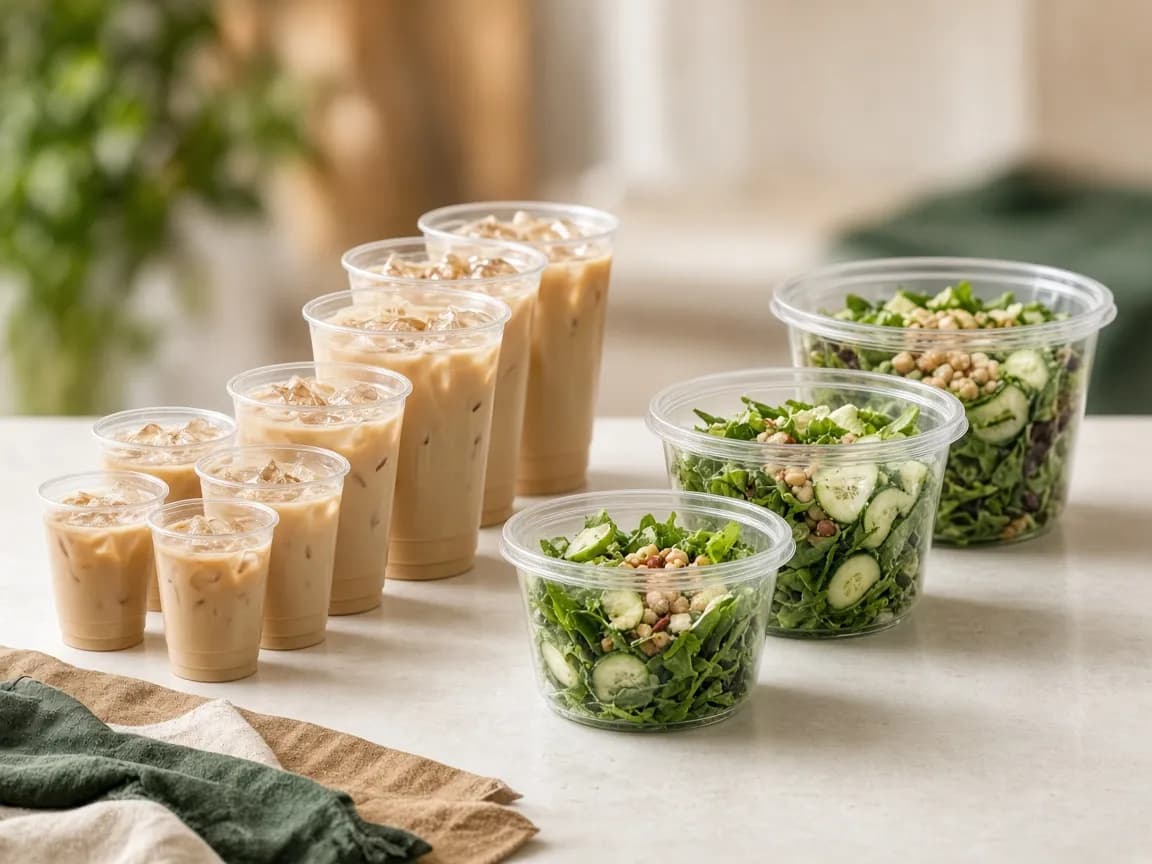
Cold cups
- 9 oz. Juice, water, and kids' drinks.
- 12 oz. Small iced coffee and iced tea.
- 16 oz. The standard iced latte or soda.
- 20 to 24 oz. Large iced tea, smoothies, and boba.
Deli containers
- 8 to 12 oz. Sides, dressings, and dips.
- 16 oz. Pint salads and cut fruit.
- 32 oz. Quart salads and family sides.
The lid is where the order goes wrong. A lid from one line may not fit a cup from another, even at the same ounce size. Order rPET cups and lids from the same line, the same way our 32 oz vs 48 oz container guide treats bowls and lids. One case of lids that will not seal can erase whatever you saved shopping the cups.
Is rPET recyclable in the Bay Area?
Sometimes. rPET is resin #1, the same as a water bottle, but that does not mean every hauler takes an rPET cup or clamshell. Bay Area cities split on it.
Rinsed rPET cups and clamshells go in the blue bin only where your city accepts them.
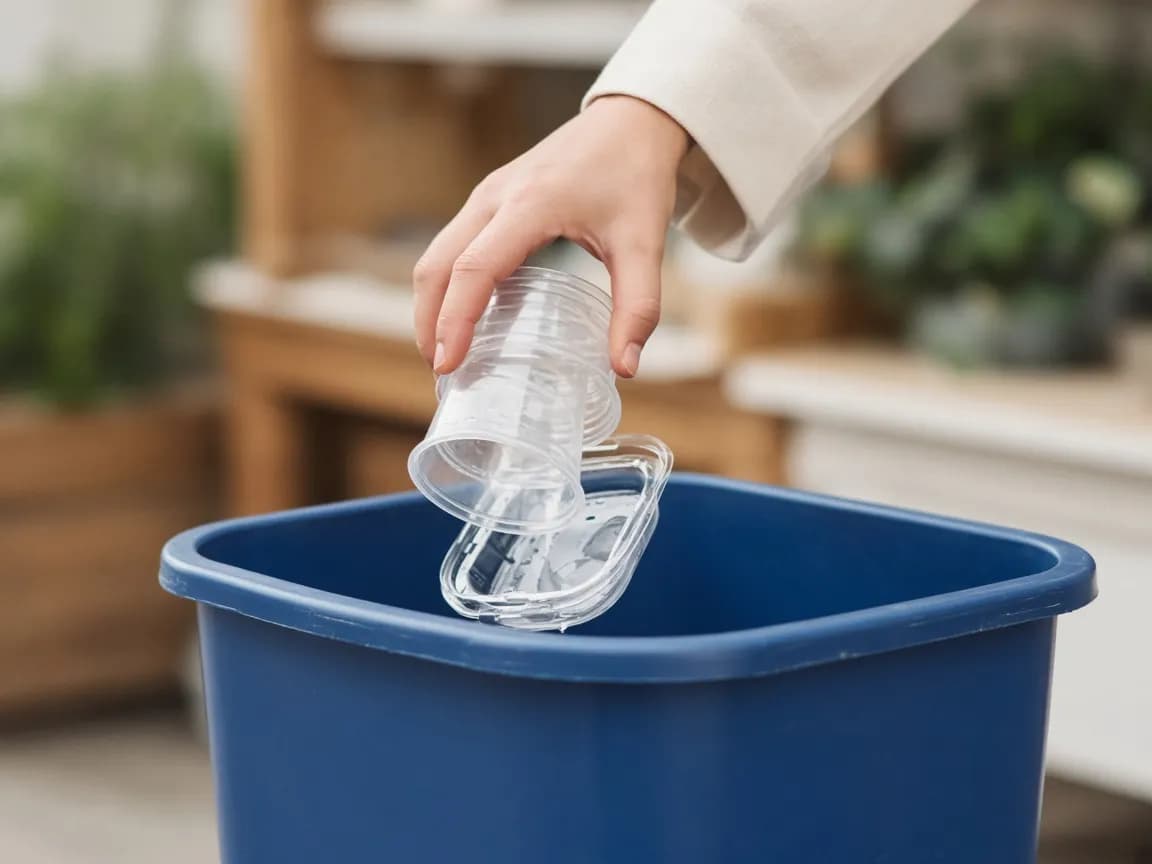
- San Francisco (Recology). Recology lists cups and lids, and clamshells for the blue cart, mostly clean and without food or liquid.
- Alameda County (StopWaste). The StopWaste clamshell guide lists clamshells as recycling in Fremont, Oakland, Dublin, Newark, Pleasanton, Piedmont, San Leandro, and Castro Valley. It lists them as garbage in Alameda, Albany, Emeryville, Hayward, and Livermore. Union City takes plastics labeled #1 and #2.
- Berkeley. The same guide says #1 clamshells are recyclable when empty and dry and garbage when food-soiled. It also says all disposable foodware sold in Berkeley must be BPI certified compostable.
- San Mateo County. The foodware ordinance bars recyclable plastic, along with traditional and compostable plastic, for cups, clamshells, bowls, and to-go boxes where it applies. Lids are an exception.
Fremont and Hayward are neighbors. The same clean rPET clamshell goes in the blue bin in one and the garbage in the other.
rPET answers where the plastic came from. Your hauler answers where it goes next.
Further reading
What California rules apply to rPET?
Four sets of rules touch rPET food packaging in California. Only one asks for recycled content, and it does not cover cups.
- AB 793, recycled content in bottles. CRV plastic beverage containers must contain at least 15 percent recycled plastic from 2022, 25 percent from 2025, and 50 percent from 2030, averaged across a maker's sales. It covers bottles, not cups or clamshells.
- SB 343, recyclability claims. The chasing arrows are reserved for material that is actually collected and recycled in California. CalRecycle says the restrictions apply to products made after October 4, 2026, and that a federal court issued a preliminary injunction on July 14, 2026 blocking enforcement. Our plastic labeling laws guide tracks it.
- SB 54, producer responsibility. Our SB 54 guide explains what it means for a food business.
- Local foodware ordinances. San Mateo County bars plastic for most disposable foodware, recycled or not, and Berkeley requires compostable foodware. Our San Mateo County ordinance guide covers the first.
The rule most likely to catch a Bay Area cafe is not the state one. It is the local one. An rPET cup that is fine in Fremont is the wrong cup in a San Mateo County city that adopted the ordinance. Check the city where the cup leaves your counter.
Further reading
Quick answers about rPET
Is rPET better than PLA?
They solve different problems. rPET goes in recycling where accepted and handles more heat. PLA goes to commercial compost where accepted. Pick the one your hauler and your city actually take. Our PLA guide covers the other side.
Is rPET biodegradable?
No. rPET is a durable plastic. It is meant to be recycled again, not to break down.
Can rPET go in the microwave?
No. PET and rPET are rated to about 150 F. Use polypropylene or fiber for anything that gets reheated.
Is rPET BPA free?
The Solo 16 oz rPET cup listing marks it BPA free. Ask for the spec sheet on any other cup before you repeat that claim to a customer.
Is rPET the same as recycled plastic?
rPET is one kind of recycled plastic: recycled PET. Recycled polypropylene, often called rPP, is another.
How much does rPET food packaging cost?
rPET is priced by the case, and in the one like-for-like comparison we checked, it cost more than plain PET. Two public listings, read in November 2026, with no California shipping restriction shown:
- Solo 16 oz clear rPET squat cold cup (RTP16D-PLANET). At least 20 percent post-consumer content, 1,000 per case, listed at $154.99. About 15.5 cents each.
- Solo Ultra Clear 16 oz PET squat cold cup (TP16D). 1,000 per case, listed at $106.49. About 10.6 cents each.
The gap is $48.50 a case, about 46 percent. A cafe that goes through four cases of 16 oz cups a month would pay about $194 more a month, or about $2,328 a year, for that recycled content at those list prices. The rPET cup also carries a printed seal, so the match is not perfect. It is the same maker, size, and shape.
What moves the price:
- Recycled content. The share of recycled PET in the cup.
- Size and wall weight. Bigger and thicker cups use more resin.
- Print. A printed seal or logo can cost more than a plain cup.
- Lids. The matching lid is a separate case. Budget the pair.
- Volume. Both listings drop the per-case price at two cases or more.
Existing Safra customers see case pricing on Cut+Dry. If you are not a customer yet, ask Safra for a quote at your volume. Many stocked items start at one case, samples can ride the next delivery, and clear Planet Choice cups and Planet Choice fiber containers come on the same weekly route. That lets you weigh what recycled content costs you against a compostable option before you commit.
How do you switch to rPET?
Switching to rPET is usually a like-for-like swap. Five steps keep it clean.
- List your clear items. Cups, lids, deli containers, clamshells, and trays, with sizes and monthly counts.
- Check your city. Confirm your hauler takes #1 cups and clamshells, and that no local ordinance bars plastic foodware where you hand it out.
- Ask for the paperwork. Get the recycled content percentage and the food contact statement for each item.
- Match lids. Order cups and lids from the same line so they fit.
- Test a case. Run one case through a busy week before you change the full order.
Run the numbers before step one. At the Solo list prices above, recycled content added almost 5 cents a cup. If your city sends that rPET cup to the garbage, or bans it, you are paying for a claim your customer never sees. That money may do more in a fiber container.
Further reading
Final thoughts
rPET is recycled PET. It is the same clear #1 plastic with the same 150 F ceiling, with a stated share pulled from used bottles and remade through a process the FDA reviews. For a cold cup or a deli container, it does the job PET does.
What it does not do is settle where the cup goes next. In San Francisco and Fremont, a clean rPET clamshell goes in the blue bin. In Hayward and Livermore, it is garbage. In Berkeley and much of San Mateo County, it is not the right foodware at all. The recycled content costs you money on every case. Make sure your city lets that money count.
If you want a second look at the clear cups and containers you buy today, send us your current list and we will match it line by line against compostable options.
Related posts
 Sustainability Legislation
What Is PLA? The Plant-Based Plastic in Food Packaging Explained
PLA is a plastic made from fermented plant sugar. Where it shows up in food packaging, how hot it can get, and where it goes after use.
Safra13 min read Sustainability Legislation
What Is Compostable Cutlery? CPLA, Wood, and Fiber Utensils Explained
Compostable cutlery is mostly CPLA, wood, or plant fiber. What each handles, where the green bin takes it, and the California rules.
Safra13 min read Sustainability Legislation
What Are Paper Straws Made Of? Paper Straws Explained
Paper straws are paper strips wound into a tube with food-safe glue. Here are sizes, PFAS rules, California straw laws, and cost.
Safra10 min read