
Compostable vs Biodegradable vs Recyclable: What the Labels Legally Mean in California
California law treats compostable, biodegradable, and recyclable as separate certified claims, not synonyms. Here is what each one actually requires.
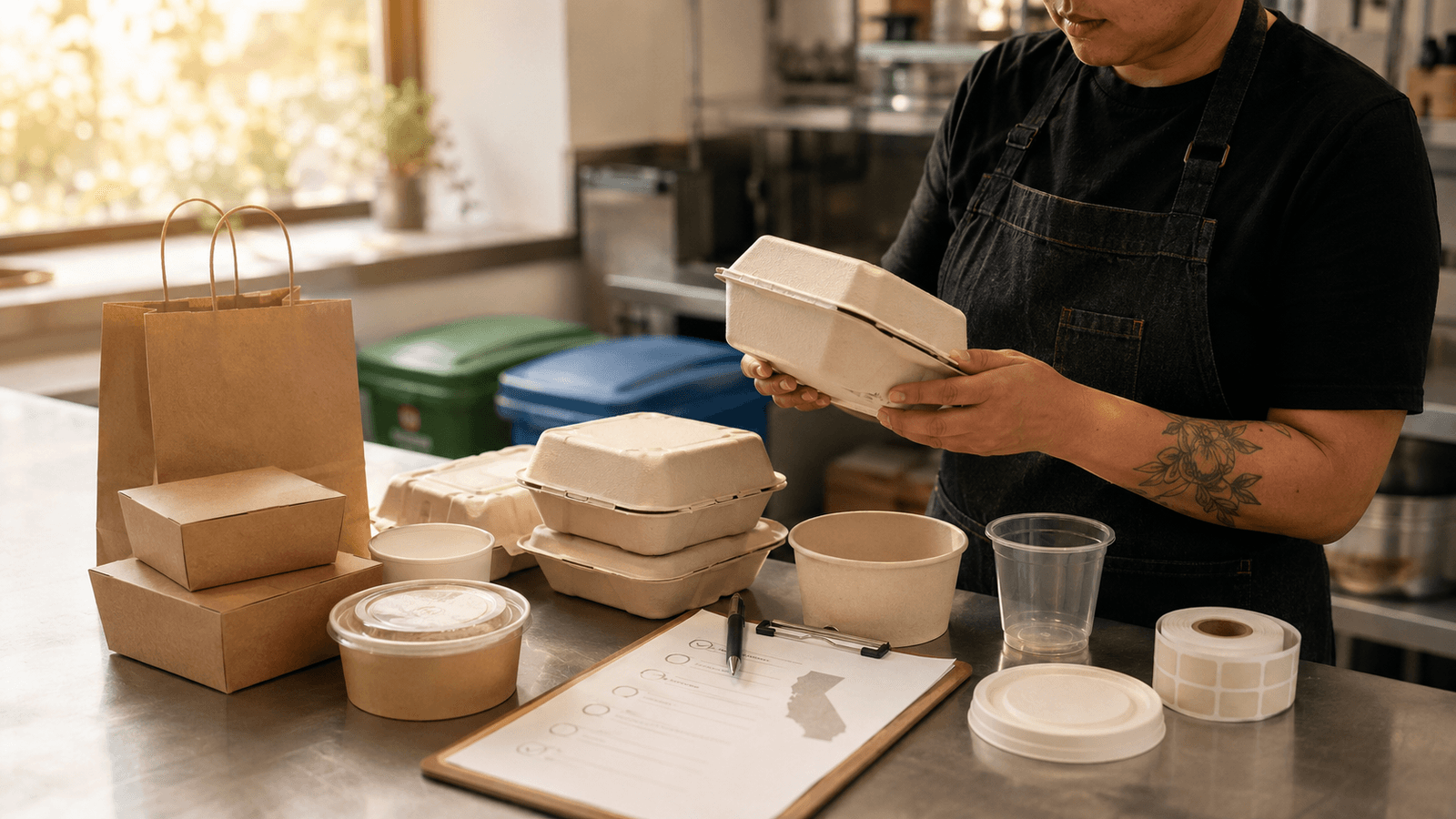
We get the same question at the loading dock almost every week: is this container compostable, or just biodegradable, and does it matter which word the box uses. It matters more than most suppliers let on. California treats these three words as separate legal claims with their own testing standards and deadlines, not as interchangeable green marketing language. This post walks through what compostable, biodegradable, and recyclable each mean under California law right now, which certifications back up a legitimate compostable claim, and where the rules are still moving.
Compostable is a tested claim, not a feeling
California has required more than a nice-sounding label since AB 1201 tightened the rules, signed by the Governor in 2021. Under the law, a plastic product cannot be sold labeled compostable or home compostable unless it meets a specific ASTM specification, the TUV Austria OK compost HOME certification, or a standard CalRecycle adopts, and the seller must be able to hand over documentation within 90 days of a request (leginfo.legislature.ca.gov/faces/billTextClient.xhtml?bill_id=202120220AB1201). In practice that means ASTM D6400 for straight bioplastics and ASTM D6868 for fiber products with a plastic-like lining. BPI is the certifier most of our foodservice customers recognize, and BPI-certified products meet ASTM D6400 or D6868 to certify they will biodegrade in a managed compost facility (bpiworld.org). AB 1201 also blocks the compostable label on products with intentionally added PFAS, since those chemicals do not break down in the compost pile and keep composters from selling the finished soil as organic (cawrecycles.org/ab1201-ting).
There is a second layer that keeps moving. AB 1201 originally said that starting January 1, 2026, a compostable label would also require the product to qualify as an allowable input under the USDA National Organic Program, a federal standard that currently does not recognize bioplastics. CalRecycle pushed that requirement back to June 30, 2027, after the Biodegradable Products Institute petitioned for more time while USDA catches up (resource-recycling.com/recycling/2025/06/17/california-extends-compostable-labeling-law). We do not treat that delay as permanent. If you are buying molded fiber or PLA-lined cups on a contract, ask your supplier what happens to their compostable claim after mid-2027.
Biodegradable, degradable, decomposable: mostly off the table for plastic
These words get used loosely online, but California law is not loose about them. Existing law prohibits selling a plastic product labeled biodegradable, degradable, or decomposable, or implying that it will break down, fragment, biodegrade, or decompose in a landfill or other environment, unless it meets one of a short list of specified standards (leginfo.legislature.ca.gov/faces/billTextClient.xhtml?bill_id=202120220AB1201). The practical effect is that a plain plastic bag or utensil printed with the word biodegradable and nothing else is very likely non-compliant in this state. Biodegradable is also not a synonym for compostable. A material can technically biodegrade over years in the wrong environment and still leave behind microplastics or fail to break down within a compost cycle. If a rep tells you a product is biodegradable but cannot name an ASTM test or a certifier, we treat that as a pass on the item.
Recyclable: the chasing arrows now need proof behind them
Recyclable claims went through their own overhaul with SB 343, the Truth in Recycling law. CalRecycle explains that the law prohibits use of the chasing arrows or any other indicator of recyclability on products and packaging unless certain criteria are met, and that these restrictions apply to products and packaging manufactured after October 4, 2026, eighteen months after CalRecycle published its statewide Final Findings Report (calrecycle.ca.gov/wcs/recyclinglabels). Products made before that date are not subject to the restriction no matter when sold. This mostly touches certain rigid plastics for our customers, since paper goods are rarely in question. If a takeout container still carries a chasing arrows symbol for a resin your local hauler does not actually collect, that label is heading toward a legal problem for the supplier, not just an environmental one.
Recyclable paper carryout bags are the compliant answer under the state's separate bag law too. We covered the checkout fee and the recycled content floor in our post California Paper Bag Law: What Changed in 2026 and What Comes in 2028, and the short version is that paper clears the recyclability bar that plastic film increasingly cannot.
What we ask suppliers before it hits our dock
When a new compostable line comes in, we ask for the actual BPI certificate or TUV Austria listing, not just a logo on the case. We check whether the certification is commercial or home compostable, since the two are not interchangeable. TUV Austria's OK compost HOME scheme is built specifically for backyard-temperature composting, while standard BPI and ASTM D6400 certification is written for industrial facilities running at much higher, sustained heat (en.tuv.at/ok-compost-home-en). A product certified only for industrial composting does not belong in a customer's backyard bin, and we say so on the shelf tag. If your county or city requires fiber-based, PFAS-free foodware specifically, like San Mateo County does, a compostable label alone will not prove compliance; we cover the fiber and accessory rules in our post San Mateo County Foodware Ordinance Explained for Restaurant Owners.
FAQ
Is biodegradable legally the same as compostable in California?
No. Biodegradable, degradable, and decomposable claims on plastic sit under a narrower set of standards than the compostable label, and a product can be technically biodegradable without ever qualifying as compostable (leginfo.legislature.ca.gov/faces/billTextClient.xhtml?bill_id=202120220AB1201).
Does a BPI certification mean I can compost the item at home?
Not automatically. Standard BPI certification is based on ASTM D6400 or D6868, which are industrial composting standards. Home compostability is a separate claim, backed mainly by TUV Austria's OK compost HOME scheme (en.tuv.at/ok-compost-home-en, bpiworld.org).
When does the compostable labeling deadline actually kick in?
The USDA organic input requirement inside AB 1201 was set for January 1, 2026, but CalRecycle extended it to June 30, 2027 for products that otherwise meet every other compostability requirement (resource-recycling.com/recycling/2025/06/17/california-extends-compostable-labeling-law).
Can I still put a recycling arrow on my packaging?
Only if the material actually meets the state's recyclability criteria once the SB 343 restrictions apply to packaging manufactured after October 4, 2026. CalRecycle does not pre-approve labels; the burden is on the seller to have the data behind the claim (calrecycle.ca.gov/wcs/recyclinglabels).
Compostable, biodegradable, and recyclable are three separate legal claims in California, each with its own certification path and its own paper trail if a regulator or a customer ever asks for proof. We would rather walk you through a real BPI or TUV Austria certificate at the dock than sell you a case of vaguely eco-friendly cups you cannot legally label that way. Browse certified compostable and recyclable foodware at safradistribution.com/#collections, or reach out through safradistribution.com/become-a-customer to set up an account and talk through what your kitchen or counter actually needs.
Related posts
 Sustainability Legislation
SB 54 Packaging Law in Plain English: What It Means for Food Businesses
What the SB 54 packaging law requires, who counts as a producer, and what Bay Area food businesses need to buy differently now.
Safra6 min read Sustainability Legislation
AB 1276 Compliance Checklist: Accessories and Condiments By Request Only
A step-by-step AB 1276 compliance checklist for accessories and condiments by request only, built for Bay Area restaurant and cafe counters.
Safra5 min read Sustainability Legislation
There's No Composter Near Me, So What's the Point? The Honest Answer
Real answer on compostable packaging when there's no composter near me: what SB 1383 actually requires and what still gets landfilled.
Safra5 min read