
SB 54 Packaging Law in Plain English: What It Means for Food Businesses
What the SB 54 packaging law requires, who counts as a producer, and what Bay Area food businesses need to buy differently now.
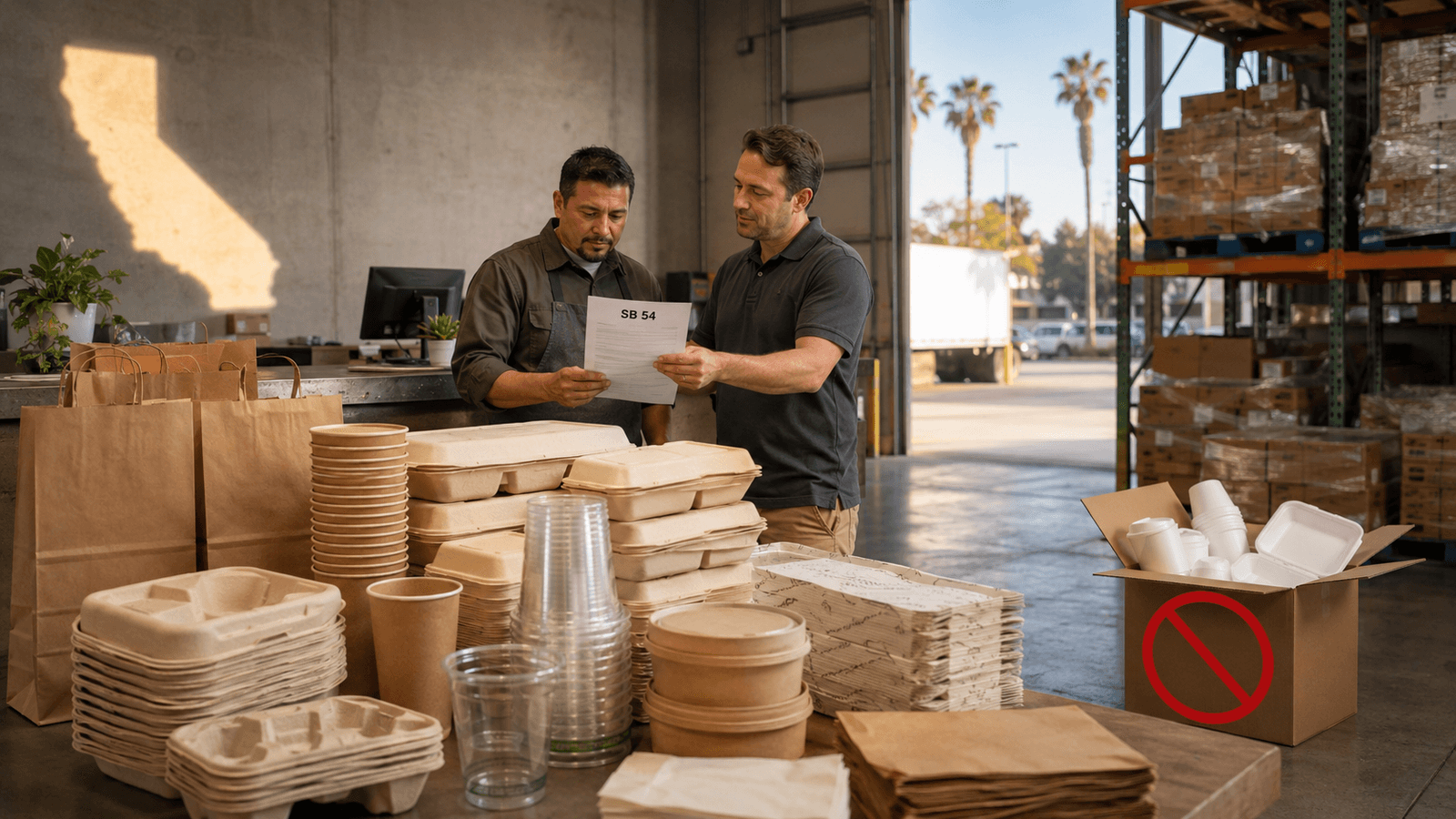
Every few weeks someone hands us a printout at the counter and asks if their restaurant needs to register under California's new SB 54 packaging law. For most of our customers the answer is no, but the law is already reshaping what we can put on a pallet, with two more compliance waves landing in 2026 and 2027. Here is what the SB 54 packaging law actually says, who it applies to, and what it means for the cups, containers, and bags you order every week.
What SB 54 Actually Requires
SB 54 is the Plastic Pollution Prevention and Packaging Producer Responsibility Act, and CalRecycle calls it the most significant overhaul of the state's packaging and recycling rules on record. It sets minimum content requirements for single-use packaging and single-use plastic food service ware, backed by an extended producer responsibility, or EPR, program (calrecycle.ca.gov/Laws/Rulemaking/SB54Regulations/). Under EPR, the companies that make and brand packaging pay into a statewide fund instead of leaving recycling costs to cities and ratepayers.
Circular Action Alliance is the single producer responsibility organization CalRecycle approved to run that fund and report compliance data. By 2032, the law requires 100 percent of single-use packaging and food service ware sold in California to be recyclable or compostable, 65 percent of single-use plastic packaging to actually get recycled, and a 25 percent cut in single-use packaging volume overall.
Who Counts as a Producer Under SB 54 (Probably Not You)
Most restaurant, cafe, and grocery owners we work with are not producers under SB 54. That obligation sits with the brand owner or manufacturer whose name is on the package, which is why the cups, foil, and napkins we distribute usually carry someone else's brand or no brand at all.
There are real exceptions. If you sell products under your own restaurant brand, such as bottled sauces, bagged coffee, or grab-and-go items, or you have packaging made under your own private label, or you import packaging into California yourself, or you use custom packaging with no supplier upstream taking SB 54 responsibility, you can be treated as the producer with your own registration and fee obligations. CalRecycle estimates the law reaches more than 5,700 producers and publishes a screening tool, Are You a Producer, worth checking if you private label anything.
The Part Already Hitting Your Loading Dock: The Foam Ban
This is the piece of SB 54 most owners feel first, because it already happened. Since January 1, 2025, polystyrene foam foodware, the Styrofoam cups and clamshells some kitchens still had on order, has been illegal to sell, distribute, or import in California. The law let EPS producers keep selling foam only if they could prove a 25 percent statewide recycling rate. They could not, so CalRecycle's own bulletin confirms EPS producers are now prohibited from selling, distributing, or importing EPS food service ware in the state.
Enforcement has kept moving, with a formal advisory from the California Attorney General on December 2, 2025 reminding EPS producers of their SB 54 obligations. Enforcement technically targets producers, not the restaurants that bought foam before the ban, but that is cold comfort if an inspector asks why you are still serving out of Styrofoam. We stopped stocking foam cups and clamshells outright, so if you still have a case in back, move to molded fiber or PP now.
Dates to Keep on Your Calendar
SB 54 rolls out in stages, and only one date below involves paperwork for a typical food business:
January 1, 2025: sale, distribution, or import of expanded polystyrene foam food service ware became illegal statewide.
May 1, 2026: CalRecycle's permanent SB 54 regulations took effect after approval by the Office of Administrative Law.
June 1, 2026: deadline for producers to join Circular Action Alliance, register independently with CalRecycle, or apply for a small producer exemption.
January 1, 2027: full implementation of the statewide EPR program begins.
2032: statewide targets take full effect, including 100 percent recyclable or compostable packaging, 65 percent plastic packaging recycled, and a 25 percent cut in single-use packaging volume.
What To Buy Now So You Are Not Scrambling Later
None of this means overhauling your program this quarter. It does mean the market is shifting toward recyclable fiber, PCR plastics, and certified compostable items, and buying ahead of that curve costs less than buying after a supplier discontinues your old SKU. We steer customers toward molded fiber clamshells, PCR-content cups, and certified compostable liners over vague eco-friendly claims, because certification holds up if a regulator asks for proof. Our posts on compostable versus biodegradable versus recyclable labels, and on BPI Certified versus OK Compost HOME, cover which certification matters where.
SB 54 is also not the only packaging rule on your plate. San Mateo County's foodware ordinance sets fiber-based, PFAS-free rules for restaurants there, and the California paper bag law changes what you can hand a customer at checkout starting in 2026. These rules stack rather than replace each other, so switching to certified compostable, PFAS-free, recyclable products tends to clear more than one requirement at once.
Frequently Asked Questions About SB 54
Does SB 54 mean my restaurant has to register with CalRecycle?
Usually not. Registration falls on producers, meaning the brand owner or manufacturer, not the restaurant buying packaging off a distributor truck. Look closer only if you sell your own branded retail items, use your own private label, import packaging yourself, or use custom packaging where no supplier upstream has taken responsibility.
Is Styrofoam actually illegal in California right now?
Yes. Since January 1, 2025, producers have been prohibited from selling, distributing, or importing expanded polystyrene foam food service ware because they could not meet the recycling rate the law required. Enforcement is active, including a December 2025 advisory from the California Attorney General, so any foam still in your kitchen should be on its way out.
How does SB 54 relate to San Mateo County's foodware rules or the paper bag law?
They overlap but are separate. SB 54 is a statewide producer program aimed at packaging makers. San Mateo County's foodware ordinance is a local rule requiring fiber-based, PFAS-free foodware. The California paper bag law governs checkout bags starting in 2026. A restaurant buying certified compostable, PFAS-free fiber packaging is generally covered across all three.
What should I switch to first?
Start with anything foam, since it is already illegal for producers to supply. After that, prioritize hot cups, clamshells, and bags, since those show up in the paper bag law, local foodware ordinances, and SB 54's compostability push at once. Certified compostable or verified recyclable fiber items tend to satisfy the most rules with the fewest SKUs.
If you want help figuring out which SKUs on your order guide are already compliant, come by the loading dock or browse what we stock at safradistribution.com/#collections. We keep certified compostable and recyclable options in case-pack and pallet quantities so you are not caught short, and if you are not yet ordering with us, you can get set up at safradistribution.com/become-a-customer.
Related posts
 Sustainability Legislation
AB 1276 Compliance Checklist: Accessories and Condiments By Request Only
A step-by-step AB 1276 compliance checklist for accessories and condiments by request only, built for Bay Area restaurant and cafe counters.
Safra5 min read Sustainability Legislation
There's No Composter Near Me, So What's the Point? The Honest Answer
Real answer on compostable packaging when there's no composter near me: what SB 1383 actually requires and what still gets landfilled.
Safra5 min read Sustainability Legislation
New California Compostable Labeling Laws: What Do They Mean for your Restaurant?
SB 343's chasing-arrows ban takes effect October 4, 2026, and AB 1201 tightens compostable claims. Here's what California restaurants need to know before ordering their next case of to-go packaging.
Safra5 min read