
AB 1276 Compliance Checklist: Accessories and Condiments By Request Only
A step-by-step AB 1276 compliance checklist for accessories and condiments by request only, built for Bay Area restaurant and cafe counters.
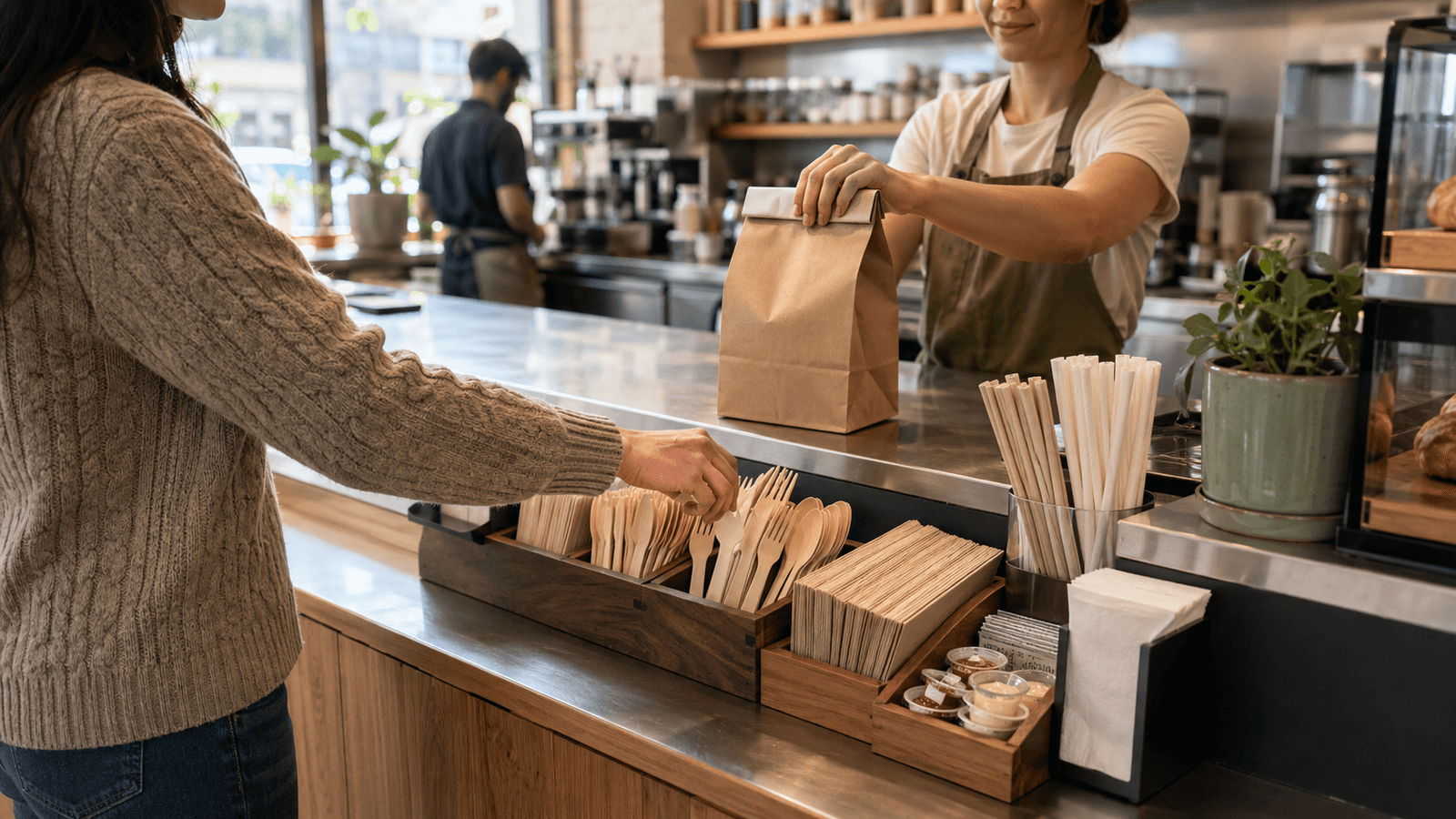
This checklist is for any Bay Area food business that hands a customer a fork, a straw, a condiment packet, or a napkin with an order: quick-service spots, cafes, delis, grocery hot bars, and ghost kitchens running third-party delivery. Run it now if you have never formally checked your setup against AB 1276 compliance requirements, and run it again any time you switch suppliers, redesign to-go packaging, or turn on a new delivery app integration.
1. Map everything that leaves the counter by default
Walk your own line for a full shift and write down every accessory or condiment that goes into a bag without anyone asking for it. AB 1276 (Carrillo, Chapter 505, Statutes of 2021) expanded the existing straws-on-request rule so it now covers all single-use foodware accessories and standard condiments distributed by food facilities or third-party food delivery platforms, and the prohibition applies regardless of material, so a compostable fork or a bamboo stirrer is not exempt just because it is not plastic. Verify by pulling five recent to-go orders and checking whether the ticket shows an actual accessory request that matches what went in the bag.
2. Break down any sealed combo utensil kits
The law does not just require a request, it also bans packaging that keeps a customer from taking only what they want, since single-use accessories and condiments provided by food facilities cannot be bundled or packaged in a way that forces a consumer to take a type they did not ask for along with the one they did. Shrink-wrapped fork-napkin-salt-pepper kits are the most common violation we see walking into new accounts. Verify by checking your current case count of sealed combo kits against individually dispensed utensils and open-stock condiment cups.
3. Reset self-serve stations to one-at-a-time, unwrapped dispensing
Self-serve condiment and utensil stands are still allowed, and a food facility offering standard condiments is encouraged to use bulk dispensers rather than single-use packets, while self-serve stations more broadly are allowed as long as items are not bundled or wrapped. A rack of loose, unwrapped forks a customer pulls one at a time is fine. A basket of shrink-sleeved utensil packs sitting next to the soda machine is not. Verify by physically checking every self-serve point in the store, not just the front counter.
4. Turn utensils and condiments into opt-in line items at the register
Your POS and any kiosk or online ordering flow should ask, not assume. Local guidance from Alameda County's waste agency recommends updating online ordering menus to let consumers request each available accessory or condiment individually, rather than dropping them all into an order automatically. Verify by placing a test order through your own online system and confirming utensils do not appear in the cart unless you actively add them.
5. Fix your delivery platform settings
DoorDash, Uber Eats, and Grubhub all have back-end settings that control whether utensils and condiments show up automatically. A food facility using a third-party food delivery platform is required to list on its menu the availability of single-use foodware accessories and standard condiments and to provide those items only when a customer requests them. Log into each platform's merchant portal yourself and confirm accessories are toggled as customer-selected add-ons, not bundled defaults, since these settings can reset after a menu update from either side.
6. Document the drive-through and airport exception, if it applies to you
A food facility may ask a drive-through customer if they want a single-use foodware accessory when it is necessary to eat the food or to prevent spills, and a facility located entirely within a public-use airport may ask a walk-through customer the same way. This is a narrow carve-out for two specific formats, not a general license to keep asking every counter customer by default. Verify by writing the exact phrasing your drive-through staff should use, then confirm it matches what they actually say.
7. Confirm you are not miscategorized under the narrow exemptions
The request-only rule does not apply to correctional institutions, health care facilities, residential care facilities, or public and private school cafeterias. If you supply one of those settings, or you operate a cafe inside one, confirm which entity is legally the food facility for compliance purposes before you assume the exemption covers your specific counter or cart. Verify by checking your food facility permit and asking your environmental health inspector directly if you are unsure.
8. Know your local enforcement contact and the fine schedule
Cities and counties were required to authorize an enforcement agency to enforce these requirements on or before June 1, 2022, and the first and second violations result in a notice of violation, with any subsequent violation punishable by a fine of twenty five dollars per day, up to three hundred dollars a year. In Fremont that enforcement sits with Alameda County environmental health. Remember too that AB 1276 sets a statewide floor, and a city or county can adopt a stricter local ordinance, as San Francisco and San Mateo County have done, covered in our posts on the San Mateo County Foodware Ordinance and California's paper bag law changes. Verify by calling your local environmental health division and asking who currently handles AB 1276 complaints in your city.
What Typically Goes Wrong When a Step Gets Skipped
The most common failure we see at the loading dock is a switch to compostable straws and forks treated as the whole compliance project, when material has nothing to do with the request-only rule. The second is a delivery platform menu that reverted to bundled defaults after a routine refresh, uncaught until a customer complained. The third is a self-serve station restocked with the wholesaler's shrink-wrapped travel packs because nobody told purchasing the sleeves needed to change. Each is an easy fix once you know to look for it, which is the point of running this checklist on a schedule instead of once and forgetting it. For the bigger packaging picture, our plain-English breakdown of SB 54 covers where AB 1276 fits, and our comparison of BPI certified versus OK Compost HOME is useful once you are ready to pick the accessory material itself.
We stock individually wrapped and bulk-dispenser utensils, straws, and condiment cups built for request-only service, in case quantities that fit a real counter instead of a warehouse. If you want to rework your accessory program for AB 1276 compliance, browse what we carry at safradistribution.com/#collections, and if you are not yet an account with us, start here: safradistribution.com/become-a-customer.
Related posts
 Sustainability Legislation
SB 54 Packaging Law in Plain English: What It Means for Food Businesses
What the SB 54 packaging law requires, who counts as a producer, and what Bay Area food businesses need to buy differently now.
Safra6 min read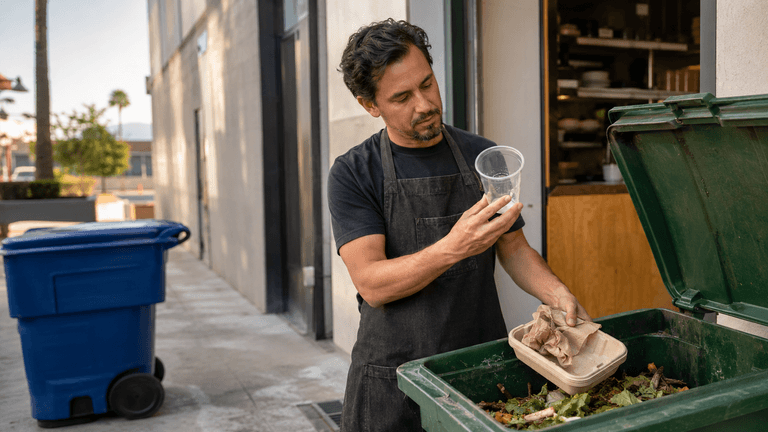 Sustainability Legislation
There's No Composter Near Me, So What's the Point? The Honest Answer
Real answer on compostable packaging when there's no composter near me: what SB 1383 actually requires and what still gets landfilled.
Safra5 min read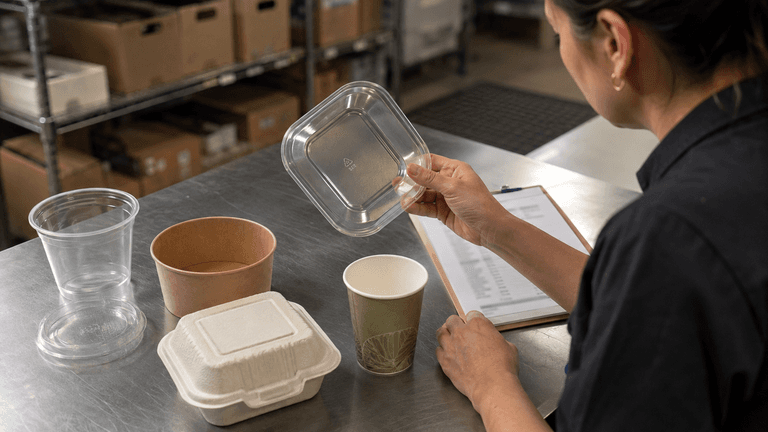 Sustainability Legislation
New California Compostable Labeling Laws: What Do They Mean for your Restaurant?
SB 343's chasing-arrows ban takes effect October 4, 2026, and AB 1201 tightens compostable claims. Here's what California restaurants need to know before ordering their next case of to-go packaging.
Safra5 min read