
There's No Composter Near Me, So What's the Point? The Honest Answer
Real answer on compostable packaging when there's no composter near me: what SB 1383 actually requires and what still gets landfilled.
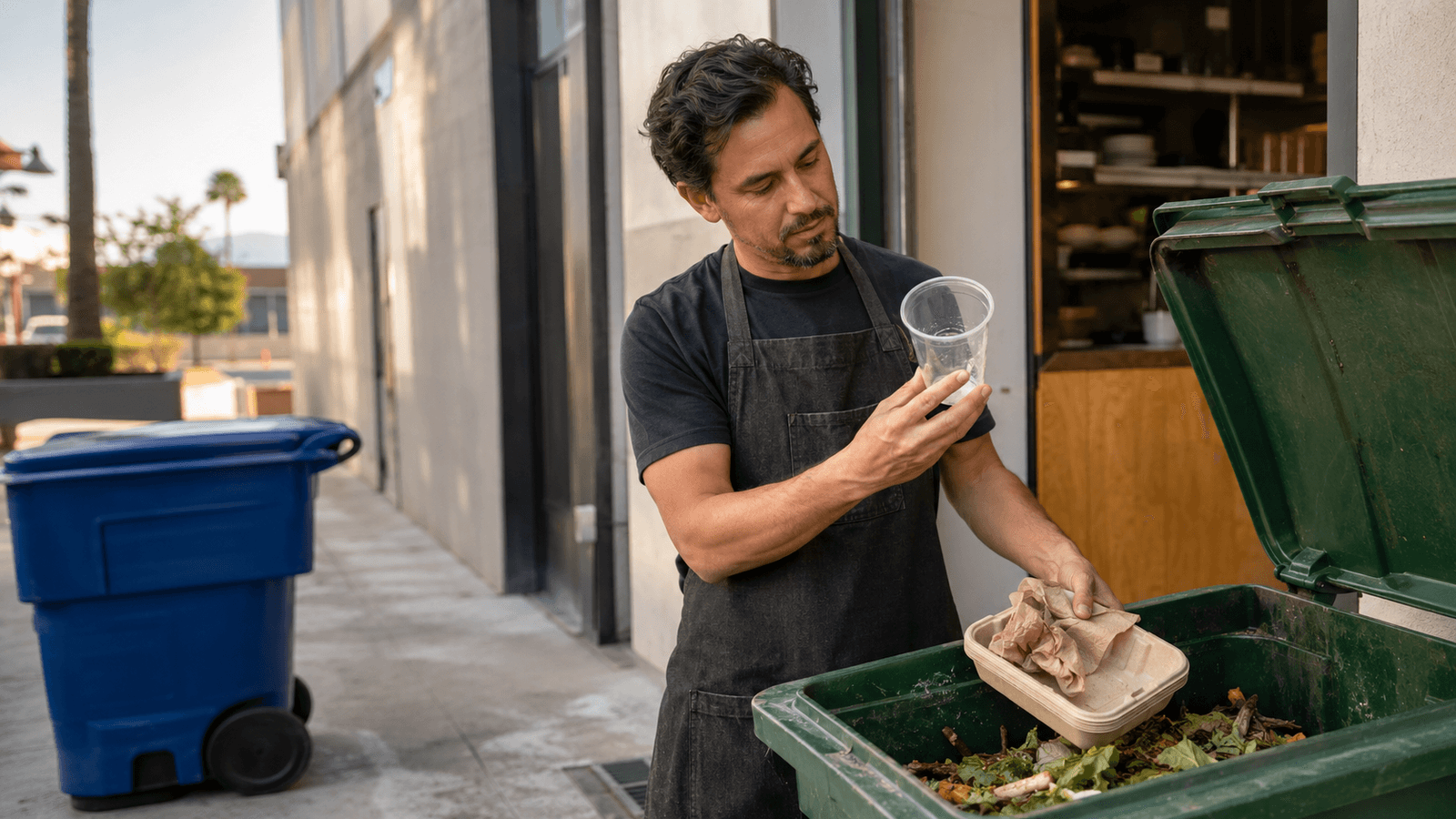
"There's no composter near me, so why am I paying more for compostable containers?" We hear a version of this question almost every week at the dock, usually from an owner who just got a delivery of molded fiber clamshells and wants to know if they are doing anything besides paying more. The honest answer has two parts, and neither one is the simple story printed on most packaging catalogs.
Your City Probably Already Runs a Green Bin Program
Before assuming there is no composter near you, check whether your city already requires organics collection at your business, because in California it almost certainly does. Under SB 1383, the state's short-lived climate pollutant law, jurisdictions are required to provide organic waste collection services to all residents and businesses, with narrow exceptions for low population or high elevation areas. A green bin already exists for your kitchen, whether or not anyone at your business ever asked your hauler to bring one.
The law exists because of what organic waste does when it is landfilled instead of composted. Methane from landfills makes up a significant share of the state's climate pollution, and organic material breaking down without oxygen is a large part of that problem. Diverting food scraps and food-soiled paper into a green bin is not a lifestyle choice under California law anymore, it is a requirement your hauler is already supposed to be meeting.
So "no composter near me" is often really "nobody set up my organics service," and that is worth a phone call before you write off compostable packaging entirely.
But a Green Bin Does Not Guarantee Your Cup Gets Composted
Here is where we get honest instead of promotional. Having curbside organics service does not mean every item labeled compostable actually ends up as compost. Most commercial composting facilities in California screen out and landfill compostable plastic, including BPI-certified PLA cups and PLA-lined items, right alongside conventional plastic, because it is treated as a contaminant in the finished product sold to farms. San Diego's Miramar Greenery facility, for example, states plainly that products labeled compostable or biodegradable, including takeout containers, cups, plates, and service ware, are not accepted in the green bin because the facility cannot reliably break them down in its processing window.
That is a very different situation from unlined paper and food-soiled fiber, which composters want. Pizza boxes, paper towels, napkins, and plain paper containers are core feedstock at most facilities, not contamination. This is the real dividing line, and it has nothing to do with whether a composter exists near you. It has to do with what kind of compostable material you bought.
Why We Still Stock Certified Fiber Over Vague "Eco-Friendly" Claims
Given that split, we steer customers toward unlined molded fiber, bagasse, and plain paper items over PLA-lined cups and plastic-look cutlery, even when nobody has confirmed exactly what the local facility screens out. Fiber-based items are far more likely to actually compost, and if they land in the landfill anyway from a sorting mistake, they still do not carry the same PFAS and microplastic concerns as some plastic and coated alternatives. We cover the difference between the "compostable," "biodegradable," and "recyclable" labels in Compostable vs Biodegradable vs Recyclable: What the Labels Legally Mean in California, worth a read before you reorder anything with a green leaf on the box.
Certification still matters even where you are unsure about local infrastructure, and not just for marketing. San Mateo County's foodware ordinance requires that most disposable foodware be non-plastic, fiber-based, and certified compostable and PFAS-free by a recognized third party such as the Biodegradable Products Institute, the Compost Manufacturing Alliance, or TUV Austria's OK compost INDUSTRIAL mark. San Francisco's mandatory ordinance goes further, requiring BPI-certified compostable bags specifically for compost collection. If you operate in either jurisdiction, the rule applies whether or not your cup ends up as finished soil. We cover the county-specific requirements in San Mateo County Foodware Ordinance Explained for Restaurant Owners, and the certification differences in BPI Certified vs OK Compost HOME: Which Certification Does Your Foodware Need, since backyard-rated and industrial-rated marks are not interchangeable.
What to Stock If You Are Not Sure Your Hauler Composts Foodware
Our practical advice at the dock is simple. Default to unlined fiber trays, plates, and boat containers for hot food, since these are the items commercial composters actually want and are least likely to be screened out. Save PLA cups and clear compostable cutlery for locations where you have confirmed with the hauler, by phone or through the jurisdiction's published accepted-items list, that they are taken. If you cannot get that confirmation, a straightforward recyclable PET or PP container is often the more honest choice than a compostable one that gets quietly landfilled anyway. We stock both in case quantities and full pallets, and we would rather walk a customer through this trade-off at the counter than sell a case of something that ends up as contamination.
FAQ
Does composting even apply to my restaurant if I am outside city limits?
Almost certainly yes. SB 1383 requires organic waste collection service from every jurisdiction, with waivers only for low population density or high elevation areas that CalRecycle has specifically approved.
Is "biodegradable" the same thing as "compostable"?
No, and mixing the two up is a common and costly mistake. Biodegradable has no enforceable timeline or standard in most contexts, while compostable, backed by BPI or TUV Austria certification, ties to a tested breakdown standard. See our full breakdown in Compostable vs Biodegradable vs Recyclable: What the Labels Legally Mean in California.
What actually happens if my compostable packaging ends up in the landfill?
It behaves like any other landfilled organic material and contributes to methane generation as it breaks down, exactly what SB 1383 is trying to reduce statewide. It is not a neutral outcome, another reason to confirm what your hauler actually accepts rather than assuming.
How do I find out if my hauler actually composts foodware, not just food scraps?
Call your hauler directly and ask for their accepted-materials list, or check your city or county sustainability department's foodware page. Do not rely on the packaging label alone, since certification tells you what the product can do under lab conditions, not what your specific facility will process.
If you want help sorting through fiber, PLA, and recyclable options for your specific menu and your specific hauler, reach out. Browse our compostable and food packaging options at safradistribution.com/#collections, or get set up as an account at safradistribution.com/become-a-customer, and we will walk through what actually gets composted in your part of the Bay Area before you commit to a pallet.
Related posts
 Sustainability Legislation
SB 54 Packaging Law in Plain English: What It Means for Food Businesses
What the SB 54 packaging law requires, who counts as a producer, and what Bay Area food businesses need to buy differently now.
Safra6 min read Sustainability Legislation
AB 1276 Compliance Checklist: Accessories and Condiments By Request Only
A step-by-step AB 1276 compliance checklist for accessories and condiments by request only, built for Bay Area restaurant and cafe counters.
Safra5 min read Sustainability Legislation
New California Compostable Labeling Laws: What Do They Mean for your Restaurant?
SB 343's chasing-arrows ban takes effect October 4, 2026, and AB 1201 tightens compostable claims. Here's what California restaurants need to know before ordering their next case of to-go packaging.
Safra5 min read