
Paper Cups vs Plastic Cups: Which Wins for Your Kitchen?
Paper cups vs plastic cups for Bay Area kitchens: hot vs cold, lids, compost rules, and Safra wholesale picks with real market price ranges.
Your espresso line wants a sturdy hot cup that will not soak through by the second sip, the smoothie bar wants clear cold cups so the drink sells itself, and the campus buyer just asked which bin those cups belong in. Foam is largely off the California table, PE-lined paper is not compostable, and PET looks like PLA under fluorescent lights. You need a clean paper cups vs plastic cups call before Friday's route.
Paper cups vs plastic cups is the kitchen decision between paperboard hot cups (PE-coated or PLA-lined) and clear PET or PP plastic cold cups, with lid style, temperature, and Bay Area compost rules deciding the winner.
Safra Distribution is the Fremont family-owned wholesale that stocks paper hot cups, clear plastic cold cups, and matching lids for Bay Area restaurants, cafes, juice shops, and caterers on weekly delivery. This paper cups vs plastic cups guide follows that path: often one-case minimums, samples on the next delivery, and live Cut+Dry pricing after you become a customer.
Key facts operators use when they compare paper cups vs plastic cups:
- Paper cups win for hot coffee, tea, cocoa, and soup because the paperboard wall plus a moisture liner handles boiling pours that warp PET.
- PET and PP plastic cups win for iced coffee, lemonade, fountain pours, smoothies, and boba when clarity, crack resistance, and a snap lid matter more than a paper look.
- Lids are not optional accessories: sip lids for hot paper cups, flat straw-slot lids for everyday iced drinks, and dome lids for whipped or topped cold drinks. Buy cups and lids as pairs.
- PE-coated paper cups are the cost workhorse; they are not compostable. PLA-lined paper cups can carry BPI commercial compost claims when certified, but local facilities and city ordinances still decide the green bin.
- Clear PLA cold cups are compostable plastic, not PET. Oakland bans compostable plastics (including PLA-lined cups) for single-use foodware, so a BPI mark is not a free pass citywide.
- Public September 2026 market listings put common PE paper hot cups roughly in the mid-$60s to mid-$70s per case by oz, while midsize PET and RPET cold cup cases often list near the mid-$100s to mid-$200s. Live Safra prices sit behind Cut+Dry sign-in.
- Safra stocks Hot Cups and Cold Cups on Cut+Dry for Bay Area weekly delivery, often with one-case MOQs and samples on the next truck.

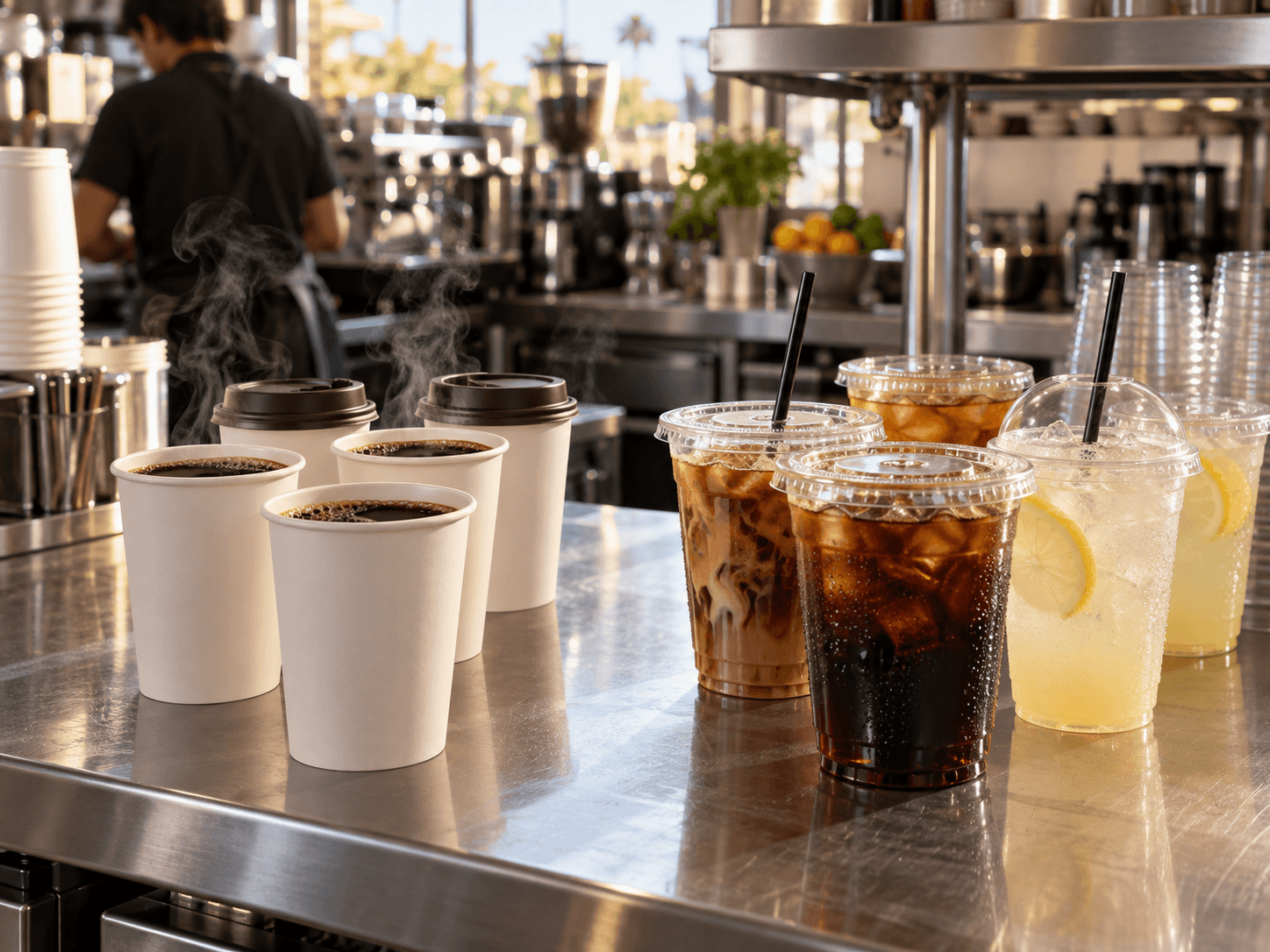
*Paper cups vs plastic cups side by side on a cafe pass with hot coffee and iced drinks*
What does a paper cups vs plastic cups decision mean for a Bay Area drink station?
When a buyer types paper cups vs plastic cups, they want the cup that survives the pour, snaps under the right lid, matches hauler rules, and still lands on the shelf next week.
Paper cups are paperboard vessels with a thin moisture barrier for hot pours. Plastic cups here mean clear PET (#1) or tougher PP (#5) for iced drinks. Compostable PLA cold cups sit in a third lane that looks like plastic but follows a commercial compost story only when certified and accepted.
A fair paper cups vs plastic cups read starts with kitchen jobs. Hot coffee belongs in paper. Clear iced drinks belong in PET or PP. Compost claims belong only where the cup, lid, certificate, and local facility agree. Safra helps Bay Area shops sample that mix on one Fremont account.
Further reading
When do paper cups win on a real menu?
Paper cups win whenever the drink leaves the kettle hot enough to soften PET. That is the core of most paper cups vs plastic cups calls for coffee programs.
Paper cups win when:
- You pour hot coffee, tea, cocoa, or broth. PE-coated or PLA-lined paperboard holds boiling pours that warp PET near about 150 to 160 F on many foodservice charts.
- You need a writeable wall. Baristas mark names on white or kraft paper faster than on clear plastic.
- Foam is restricted and you still need a familiar coffee-cup silhouette. Double wall or sleeve-ready single wall paper covers that job without EPS.
- You want a compostable hot story and your hauler accepts certified lined paper. Choose BPI-certified PLA-lined paper cups (ASTM D6868 framing), not PE-lined cups labeled eco by vibe.
- You are optimizing cost on high-volume hot pours. Public September 2026 listings put Solo-style 16 oz PE paper hot cups near about $75 per 1,000-count case (about 7 cents each), with 20 oz packs around the mid-$60s per 600-count case.
Paper cups lose clarity versus PET. They also lose if you grab a PE-lined cup and print compostable on the menu board. The liner decides compostability, not the word paper.
Further reading
When do PET or PP plastic cups win for cold drinks?
Plastic cups win the cold half of a paper cups vs plastic cups menu when customers buy with their eyes and ice is part of the product.
PET / PP plastic cups win when:
- Clarity sells the drink. Iced coffee, lemonade, juice, and smoothies move faster in clear PET than in opaque paper.
- You need crack resistance with ice. PET handles cold well; PP stretches the warm margin for some cold-to-warm builds.
- You run flat straw-slot or dome lids all day. Match PET lids by rim diameter (often 78 mm, 92 mm, 95 mm, or 98 mm depending on oz).
- Recycling, not compost, is your honest end-of-life story. PET (#1) recycles where your hauler accepts foodservice PET. It is not BPI compostable.
- Unit cost on cold volume matters. Public September 2026 listings put many midsize RPET / PET cold cup cases in roughly the mid-$150s to mid-$250s band by oz and count. Treat those as market orientation, not a Safra invoice.
Plastic cups lose on hot pours. Do not steam a latte into PET. They also lose a compostable claim: PET is not PLA, even when both look clear.

*Paper cups vs plastic cups lids: sip, flat straw slot, and dome styles*
How do lids change a paper cups vs plastic cups choice?
Lids settle more paper cups vs plastic cups fights than oz size. A cup without the right lid leaks or breaks the disposal claim when staff grab whatever snaps.
Lid map for paper cups vs plastic cups:
- Sip lids for paper hot cups. Everyday coffee and tea. Match the hot-cup rim family (often 8, 12, 16, 20 oz). CPLA or paper lids keep a compost story when the cup is PLA-lined and certified.
- Flat lids with straw slot for PET / PLA cold cups. Iced coffee, tea, soda, juice. X-slot styles grip straws better than a straight slit on many lines.
- Dome lids with straw hole for topped cold drinks. Smoothies and whipped drinks that need headspace. Domes for 12 to 24 oz cups commonly pack about 1,000 per case.
- No-hole or vented options. Confirm the SKU before you promise a sip hole.
Fit rules. Lid families are brand- and footprint-specific. Buy paper cups with sip lids and plastic cups with flat or dome lids as pairs, label shelves by footprint, and sample before you print a lid map.
Further reading
Hot vs cold: can one cup family cover both sides of paper cups vs plastic cups?
Usually no. Forcing one SKU across hot and cold is how paper cups vs plastic cups programs fail mid-rush.
Hot lane: paper hot cups (PE-coated for cost, PLA-lined when you need certified compostable hot cups your city accepts).
Cold lane: PET or PP plastic cups for clarity and recycling-oriented markets, or PLA cold cups when commercial compost is real for your hauler and ordinance.
Most Bay Area cafes settle a short ladder:
- 12 oz and 16 oz paper hot cups with sip lids
- 16 oz and 24 oz PET cold cups with flat lids
- Dome lids only for smoothie or whipped SKUs
- Optional PLA-lined paper or PLA cold cups only after you confirm the facility and city list
Map ounces to drinks, then lock lids. Safra can help you sample that list on the next delivery.

*Hot paper cup and cold plastic cup decision on a cafe bar mat*
What do Bay Area compost rules actually say about paper cups vs plastic cups?
This is where paper cups vs plastic cups gets honest. BPI certification is paperwork for commercial compostability. It is not a city ordinance and it is not a promise that your green cart accepts the item.
BPI and ASTM framing. BPI-certified items are tested for commercial compost facilities (disintegration around 58 C), with no intentionally added fluorinated chemicals and total organic fluorine at or under 100 ppm. Coated paper cups lean on ASTM D6868; PLA cold cups lean on ASTM D6400. Verify the certificate for the exact SKU on your PO.
San Francisco direction. Disposable foodware sold or distributed must be recyclable or compostable in the City's collection programs, and compostable foodware generally needs BPI or TUV certification. Confirm the current list before you print compostable on a menu board.
Oakland reality check. Oakland's Reusable Foodware Ordinance bans polystyrene foam and compostable plastics / bioplastics for single-use foodware, including PLA-lined cups. Local 2026 reporting notes Oakland's compost collector rejects bioplastic cups even when labeled compostable. In Oakland, a BPI PLA cup is often the wrong paper cups vs plastic cups answer even if the certificate is real.
PE-lined paper is not compostable. A white paper hot cup with a polyethylene liner holds coffee well and still belongs outside a compost claim.
Labeling. SB 343 and AB 1201 restrict compostable and recyclable claims. Do not call PET cups compostable, PE-lined paper cups compostable, or PLA cups recyclable in the PET stream.
Further reading
What do paper cups and plastic cups cost wholesale in 2026?
Safra does not publish a public price list. Live paper cups vs plastic cups case pricing sits in the Hot Cups and Cold Cups categories on Cut+Dry after you sign in. A September 2026 check could not read public dollar amounts without customer sign-in. Use public ranges as orientation only, then ask for a quote at your volume.
Public September 2026 retailer listings put common PE paper hot cups roughly here:
- Solo-style 16 oz white poly paper hot cups, about 1,000 per case: near about $75 (about 7 cents each)
- Solo-style 20 oz white poly paper hot cups, about 600 per case: near about $65
- Nearby compostable paper hot cup alternatives often list a modest premium over PE
Clear plastic cold cups often land higher per case:
- Midsize 16 oz RPET / PET cold cups, about 1,000 per case: often near the mid-$150s to high-$180s
- 20 oz RPET cold cups, about 1,000 per case: listings near about $250 on some carts
- 24 oz RPET cold cups, about 600 per case: listings near about $150 to $195
- PLA compostable cold cups (1,000-count) often sit roughly in the about $200 to $380 band by oz
Matching lids usually pack about 1,000 per case and cost less than the cups on public charts. Ounce size, lid style, and freight move paper cups vs plastic cups landed cost more than the logo. A local weekly program usually lands cleaner than scattered parcel freight.
Which Safra Cut+Dry cup picks should you sample first?
Start with the jobs on your ticket board. A practical paper cups vs plastic cups sample set for most Bay Area cafes:
- 16 oz paper hot cup + matching sip lid. Workhorse hot pour for coffee and tea.
- 12 oz paper hot cup + matching sip lid. Smaller hot drinks without wasting a large wall.
- 16 oz PET cold cup + flat straw-slot lid. Everyday iced coffee and lemonade clarity.
- 24 oz PET cold cup + flat or dome lid. Larger iced drinks and many smoothie builds.
- Optional PLA-lined paper hot cup or PLA cold cup. Only after you confirm city acceptance; skip in Oakland-style bioplastic bans.
Ask Safra for case packs and certificates on stocked items. Often you can start with one-case minimums, put samples on the next Bay Area delivery, and lock the winning paper cups vs plastic cups mix before you print a menu claim.

*Wholesale cases of paper cups and plastic cups ready for Bay Area delivery*
How do Bay Area kitchens buy paper cups vs plastic cups wholesale from Safra?
Paper cups vs plastic cups buying fails when hot cups, cold cups, and lids travel on different POs. Lock the pairs, then lock the route.
- List hot ounces, cold ounces, weekly burn, straw vs dome need, and city constraints (Oakland bioplastic bans, SF compost lists, hauler rules).
- Pick one lid family per footprint so staff cannot grab the wrong lid mid-rush.
- Become a customer so you can see live case pricing on Cut+Dry.
- Ask for samples on the next Bay Area delivery; run hot pour, ice, leak, and straw tests.
- Start with one-case minimums on winning paper cups and plastic cups, then lock a weekly Fremont route.
- Reorder from Hot Cups and Cold Cups on Cut+Dry once the mix is stable, and keep BPI paperwork only for SKUs you claim as compostable.
Safra is the better buy for paper cups vs plastic cups when you need weekly Fremont inventory on Bay Area routes, with cups and lids under one account.
FAQ: paper cups vs plastic cups
Can I pour hot coffee into a PET plastic cup?
No. PET softens under hot liquid on typical foodservice charts. Use paper hot cups for coffee and tea. Keep PET and most PLA cold cups for iced drinks only.
Are paper cups automatically compostable?
No. Most conventional paper cups use a PE liner that is not compostable. Compostable hot cups use a certified bio-based liner such as PLA plus paperwork and a facility that accepts them.
Are clear plastic cups compostable?
Only if they are certified PLA, not PET. Clear PET cups recycle where accepted; they do not follow a BPI compost path. Never mix a PET lid onto a PLA cup if you need one organics claim.
What lids do I need for paper cups vs plastic cups?
Sip lids for paper hot cups. Flat straw-slot lids for iced PET or PLA cups. Dome lids for topped smoothies. Match rim families and sample before you standardize.
Does Oakland allow compostable plastic cups?
Oakland bans compostable plastics / bioplastics for single-use foodware, including PLA-lined cups. Confirm current guidance before you advertise compostable cups there. Other Bay Area cities differ.
What is the minimum order for cups from Safra?
Many Safra cup SKUs are one-case friendly. Ask for a quote at your volume for mixed pallets. Samples can often ride the next Bay Area delivery.
Where do I see live cup case prices?
Sign in to the Hot Cups and Cold Cups categories on Cut+Dry after you become a customer. Public ranges in this paper cups vs plastic cups guide are orientation only.
Final thoughts
There is no single winner, and that is the point of a real paper cups vs plastic cups decision. Paper cups win for hot pours, writeable walls, and (when truly PLA-lined and accepted) compostable hot programs. PET and PP plastic cups win for cold clarity, ice, and recycling-oriented markets. Lids, temperature, and local compost rules decide the PO more than a brochure photo.
What should not be a debate is matching cups and lids as pairs, refusing to print compostable on PE-lined paper or PET, checking Oakland-style bioplastic bans before you buy PLA, and buying from a local weekly route so cases show up before the lunch rush.
At Safra Distribution, we supply Bay Area restaurants with paper hot cups, clear plastic cold cups, and matching lids. If you are ready to settle paper cups vs plastic cups for your menu, browse safradistribution.com/#collections or reach out through safradistribution.com/become-a-customer and we will help you match the right cups and lids to your drinks.
Related posts
 Food Containers
Imperial Dade Is Now Imperial Brady: What It Means for Your Packaging Supply
Imperial Dade is now Imperial Brady after the BradyPLUS merger. What Bay Area packaging buyers should check on invoices, accounts, and local supply options.
Safra11 min read Food Containers
6.6 x 4.7 vs 9.1 x 4.8 Sushi Tray: Which Fits Your Menu?
6.6 x 4.7 vs 9.1 x 4.8 sushi trays compared for California kitchens: nigiri sets, rolls, combo platters, portion cost, and bagasse vs PET options from Safra.
Safra12 min read Food Containers
Compostable Cold Cups and Lids in Bulk
Compostable cold cups and lids in bulk for Bay Area shops: sizes, BPI and PFAS notes, case packs, and Safra wholesale delivery.
Safra13 min read