BPI Certified vs OK Compost HOME: Which Certification Does Your Foodware Need
BPI and OK Compost HOME are not interchangeable. Here is what each certification tests and which one your foodware needs to pass in the Bay Area.
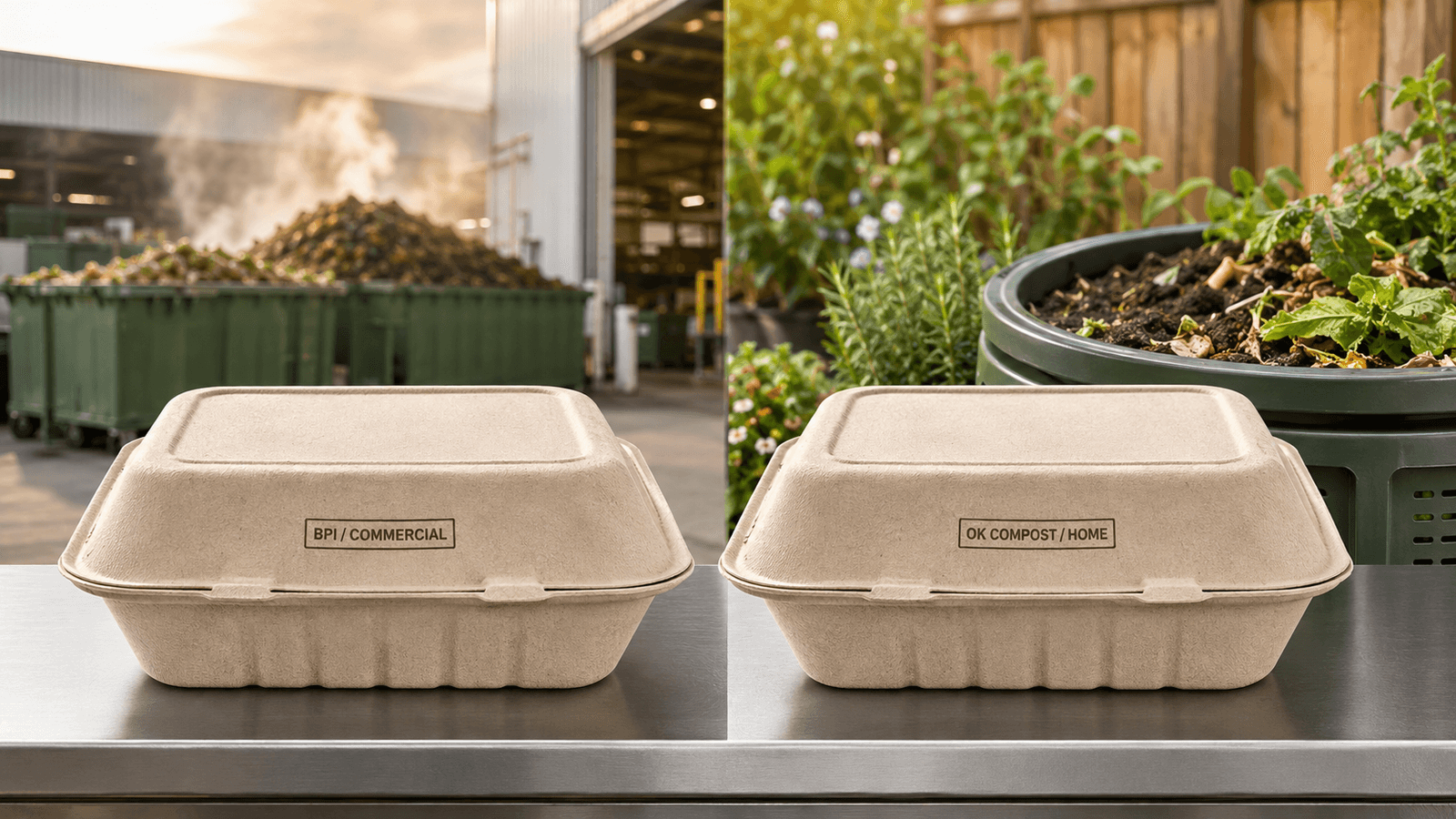
A compost hauler once told us the fastest way to get a load rejected is a case of clamshells stamped with the wrong green logo. Every few weeks someone stands at our counter holding two lids that look almost identical and asks which one their program actually takes. Both say compostable. Both carry a certification mark. But BPI certified and OK Compost HOME are verifying two different things, and mixing them up can mean a pallet gets pulled from the organics stream and landfilled instead. Here is what each mark actually tests, and which one your kitchen needs depending on where the item ends up after the bus tub.
What BPI Certification Actually Tests
BPI stands for the Biodegradable Products Institute, and it is the mark most Bay Area haulers look for on foodware headed to a commercial facility. The Biodegradable Products Institute provides certification services for compostable products, and BPI-certified products meet ASTM D6400 or D6868 testing standards to certify they will biodegrade in a managed compost facility (bpiworld.org). BPI uses ASTM D6400 as the base standard for assessment for all items going through the BPI Certification process, with optional assessment to ASTM D6868 for coated paper and D8410 for fiber-based substrates (bpiworld.org/compostability-certification). Products certified by BPI meet ASTM standards for compostability, are subject to eligibility criteria tied to food scraps and yard trimmings, meet limits for total fluorine, and must display the BPI Certification Mark (bpiworld.org). That fluorine limit is effectively a PFAS ceiling, the same concern behind the foodware rules we cover in our San Mateo County Foodware Ordinance Explained post.
What OK Compost HOME Actually Tests
OK Compost HOME is a different scheme, run by TUV Austria rather than BPI. OK compost HOME is a certification scheme for products that are degradable in home composting, and it forms the basis of several national standards used outside the United States (okcert.tuvaustria.com). The distinction that matters at the loading dock is temperature. A backyard pile never reaches the sustained heat of a commercial windrow, so products carrying the OK Compost HOME mark are deemed compostable at a lower temperature than the OK Compost INDUSTRIAL mark requires. A container that passes OK Compost HOME will break down in a backyard bin over a season. That says nothing about whether a commercial hauler will take it, because commercial facilities are built around industrial-speed breakdown, not backyard timelines.
Why the Difference Decides What You Can Legally Buy
This is not a technicality for anyone buying foodware for a Bay Area kitchen. San Mateo County's ordinance names the marks that satisfy the rule directly. Food service businesses are required to use natural fiber-based foodware certified compostable by BPI, CMA, or TUV Austria OK Compost INDUSTRIAL (smcsustainability.org/waste-reduction/food-service-ware-ordinance). OK Compost HOME is not on that list, because the county's compost partners run industrial facilities, not backyard piles. If a supplier hands you a case stamped only with the HOME mark, it will not satisfy the county's fiber-based, compostable requirement, no matter how green the logo looks. We walk through the rest of what that ordinance requires, including the PFAS accessory rules, in our San Mateo County Foodware Ordinance Explained post. The same logic holds even outside the county. Ask your hauler which facility receives your organics before committing to a case count, because a compostable stamp that does not match your hauler's process gets pulled at the transfer station and landfilled anyway.
What We Check Before It Leaves the Dock
When a new account calls about switching lines, we ask two questions before we quote a pallet. First, who picks up the organics, and do they run their own facility or contract it out. Second, what does the case label actually say: BPI with the D6400 or D6868 reference, or an OK Compost HOME logo with no industrial equivalent listed. We have had orders come in for forty cases of a HOME-only clamshell meant for a catering client whose hauler does not accept it at all. We would rather spend twenty minutes on the phone confirming than ship product that gets rejected on delivery day. Lead times on BPI-certified fiber lines run about one to two weeks out of our Fremont warehouse for standard sizes, longer for printed runs, so this is worth sorting out before your current case count runs out, not the week after.
FAQ
Can I use OK Compost HOME foodware in a commercial composting program?
Usually not without checking first. OK Compost HOME verifies backyard-level breakdown, and most Bay Area organics haulers and municipal ordinances, including San Mateo County's, list BPI, CMA, or OK Compost INDUSTRIAL as the accepted marks (smcsustainability.org/waste-reduction/food-service-ware-ordinance). Call your hauler before you buy a pallet of anything carrying only the HOME mark.
Does BPI ever certify home compostable products too?
Yes, BPI runs a separate home certification alongside its commercial program, and the two use different disintegration benchmarks. BPI requires disintegration to ISO 16929 or 20200 under home temperatures and timeframes for that home track, which is a distinct test from the commercial D6400 based program most foodware carries (bpiworld.org/faq).
Is biodegradable the same as compostable under California law?
No, and mixing the two up on a menu insert or a case order is a common mistake. We break down the legal difference, and why an uncertified biodegradable claim can get a product pulled from shelves, in our Compostable vs Biodegradable vs Recyclable post.
Which mark satisfies the San Mateo County foodware ordinance?
BPI, CMA, or TUV Austria's OK Compost INDUSTRIAL mark on fiber-based items, not OK Compost HOME (smcsustainability.org/waste-reduction/food-service-ware-ordinance). Larger items like bowls, plates, and clamshells also need to meet the county's low-fluorine, PFAS-related limits, which we cover in our San Mateo County Foodware Ordinance Explained post.
If you are re-checking your foodware case labels this quarter, we can walk through what is currently on the shelf at our Fremont warehouse and confirm which marks match your hauler's program before you commit to a pallet. Browse the compostable and fiber-based lines at safradistribution.com/#collections, or reach out through safradistribution.com/become-a-customer and we will get your account set up.