
San Mateo County Foodware Ordinance Explained for Restaurant Owners
What the San Mateo County foodware ordinance requires: fiber-based containers, PFAS-free compliance, and accessories by request only.
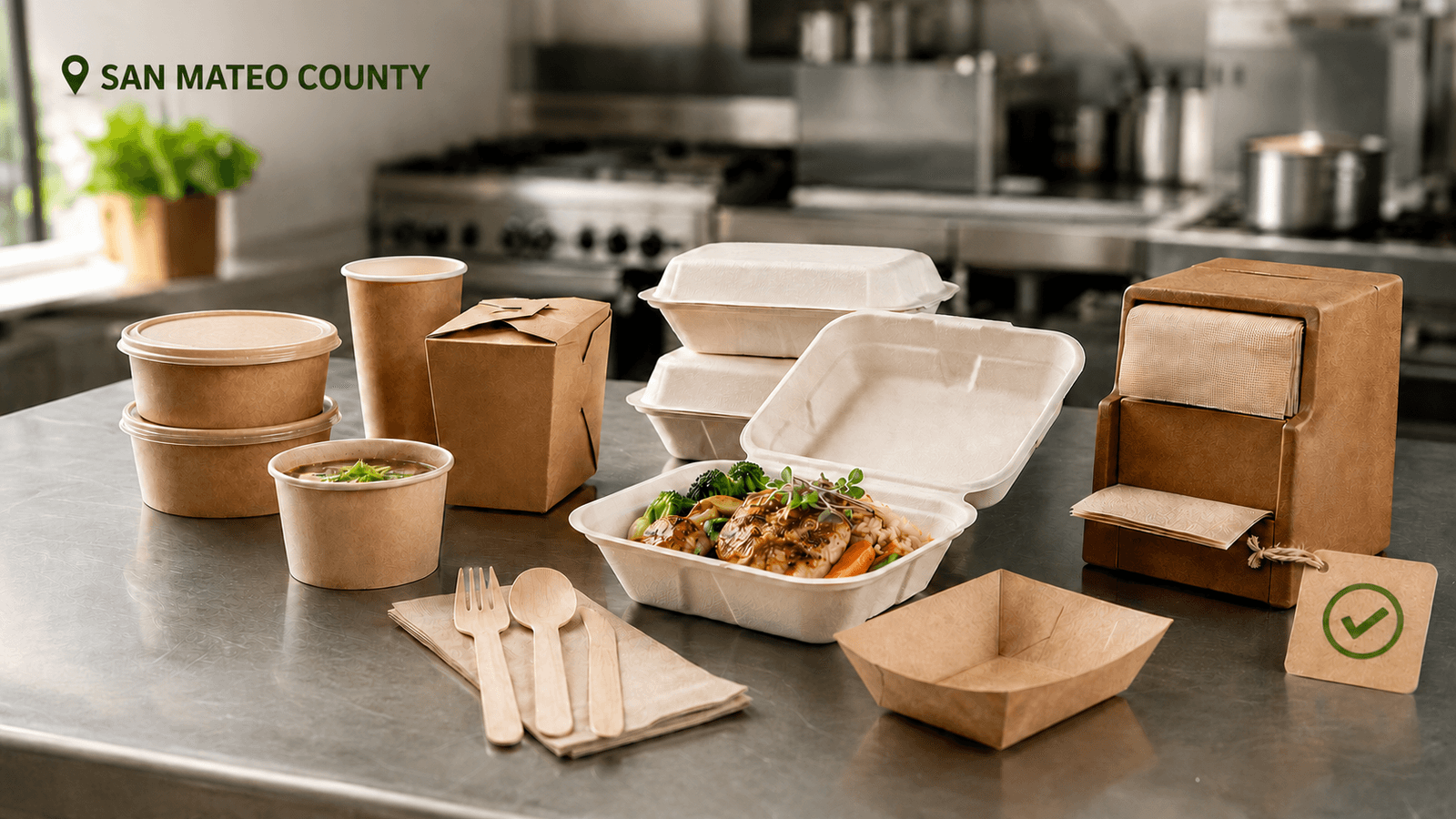
If you run a kitchen anywhere from Daly City to Redwood City, you have probably already had a health inspector or a rep from us ask about your to go containers. The San Mateo County food ware ordinance is the reason. It is not the statewide bag rule everyone has been asking about lately, and it is not new. It has been on the books since 2021 and fully enforced since October 1, 2022, and it changes what you can put hot food into, not what you carry groceries home in. Here is what the ordinance actually requires, in plain terms, and what we stock at our Fremont warehouse to keep you compliant.
What the San Mateo County Food ware Ordinance Covers
The county's Disposable Food Service Ware Ordinance is codified in County Code Chapter 4.107, and most cities within the county, San Mateo, San Carlos, San Bruno, Redwood City, Daly City, Foster City, and Pacifica among them, have adopted matching or stricter versions of their own. The rule applies broadly to any food facility that stores, prepares, packages, or serves food for human consumption, which in practice means restaurants, cafes, delis, mobile food trucks, and grocery hot bars. If you hand a customer prepared food in a disposable container anywhere in the county, this ordinance applies to you, whether you are a single counter operation or running multiple locations.
The ordinance groups requirements into three buckets: what larger food ware items are made of, whether that food ware carries PFAS, and how accessories like straws and utensils get handed out. We will take each in turn, because kitchens tend to get tripped up on one or two of these and assume the whole order is compliant.
Fiber-Based Only: What You Can and Cannot Order
Larger disposable food ware, plates, bowls, cups, food trays, clamshells, boxes, and deli containers, has to be made from natural fiber. That means paper, sugarcane, bamboo, wood, wheat stalk, or hay. Aluminum and glass are also allowed if that fits your menu better than molded fiber. Standard plastic and foam are out, and so is most bioplastic, since the county's own guidance is clear that traditional and compostable plastics like PLA are not permitted for these larger items.
One detail that catches operators off guard: lids are treated a little differently than the container itself. A plastic lid on a fiber cup or bowl is allowed as long as your hauler actually accepts it in the local recycling or composting stream, so it is worth checking with your waste hauler before you commit to a case of anything with a plastic lid. This is the same fiber-first logic behind the changes in our post on the California paper bag law, which covers the separate statewide rule on checkout bags rather than dine-in food ware. The two rules come from different bills and different agencies, but they both push kitchens toward paper and fiber first.
PFAS-Free Compliance: The 100 ppm Line
PFAS, the fluorinated chemicals used to make paper food ware grease and water resistant, are the second piece. The county code defines compliant food ware as either having no intentionally added PFAS, or testing below one hundred parts per million of total organic fluorine. That threshold matters because a molded fiber bowl can look and feel identical to a compliant one while still carrying a fluorinated coating you cannot see. This is exactly why we ask suppliers for PFAS test documentation before we bring a new fiber SKU into our warehouse, and why we can hand that documentation to you if your health inspector asks.
San Mateo County's own health department frames the health risk plainly, noting that these chemicals have been linked to serious health concerns, which is part of why the county moved on this ahead of the state's own PFAS restrictions on food packaging that took effect January 1, 2023 under AB 1200. If you are stocking clamshells, deli tubs, or trays right now, PFAS-free is not a nice-to-have. It is the baseline.
Accessories by Request Only: The Counter Rule
The third piece is about behavior at the register more than it is about materials. Straws, stirrers, cup sleeves, condiment packets, utensils, cocktail picks, toothpicks, and napkins all count as accessories under the ordinance, and they cannot be bundled into every to go bag automatically. They go out only when a customer asks for them, or through a one-at-a-time dispenser at a self-serve station. You cannot leave a pile of wrapped forks on the counter for people to grab handfuls of on their way out.
For a lot of the counter service spots we work with, this is the easiest rule to follow once staff get used to asking rather than auto-including, and it is also the rule that saves the most money over a year, since fewer unused utensil sets end up in the trash. It does mean training your front counter and your delivery packing station to ask the question instead of tossing in a fork by habit, and it means keeping accessories behind the counter rather than in a bin customers can reach into.
FAQ
Does the San Mateo County food ware ordinance apply outside city limits, in unincorporated areas? Yes. The county ordinance applies countywide, and most incorporated cities within San Mateo County have adopted their own version, in some cases with extra requirements layered on top, so check your specific city's rule as well as the county's.
Is compostable plastic, like PLA, allowed under the ordinance? No. The county's guidance is explicit that plastics, whether traditional petroleum-based or compostable bioplastics such as PLA, are not allowed for either the larger food ware items or the accessories covered by the rule. Fiber, aluminum, and glass are the compliant options.
Can we still keep straws and napkins available at a self-serve station? Yes, as long as they are dispensed one at a time rather than left in an open pile or handed out automatically with every order. The point of the rule is to stop automatic distribution, not to ban self-serve entirely.
Do plastic lids on fiber cups violate the ordinance? Not automatically. A plastic lid is generally allowed if it is accepted by your local hauler's recycling or composting program, so confirm that with your hauler before ordering a full case.
We keep fiber-based, PFAS-free plates, bowls, clamshells, and deli containers in stock at our Fremont warehouse specifically because we get asked about this ordinance at the loading dock on a regular basis, along with the accessory packs that make the by-request rule easy to follow. If you want to see what is compliant and ready to ship, visit safradistribution.com/#collections, and if you are not yet ordering with us, start at safradistribution.com/become-a-customer and we will get your account set up.
