
Sushi Trays Wholesale: Bulk Options for Takeout and Retail
Which sushi tray sizes to stock, what PET, OPS, and fiber trays cost per case, and the two California rules that change what goes in the bag.
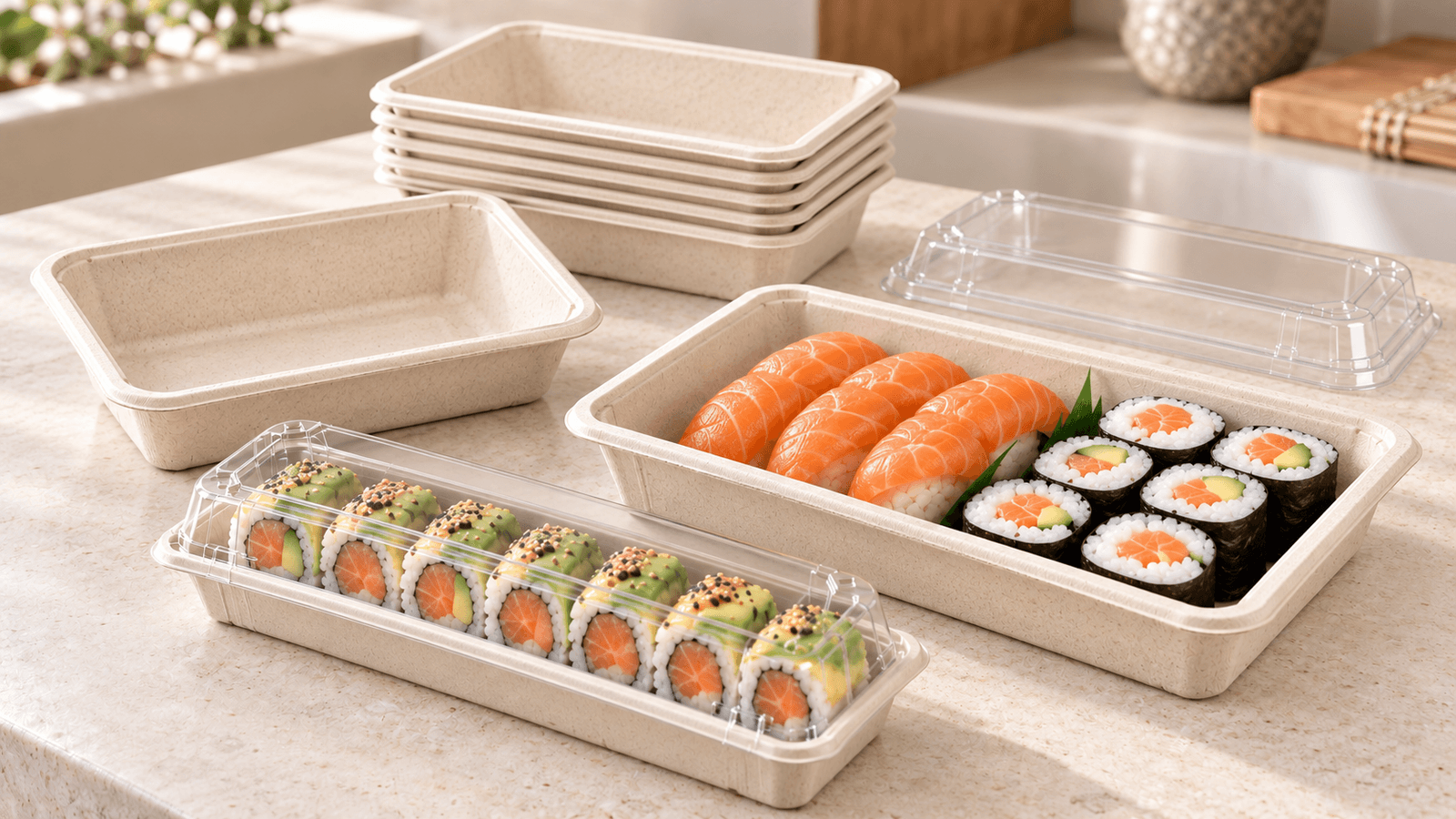
If you sell sushi to go, the tray is part of the product. A roll that slides around in a loose lid, sweats under fluorescent light, or arrives with the lid popped is a refund waiting to happen. Buying sushi trays wholesale fixes the cost side, but only if you buy the right footprint, the right material, and the right lid for how you actually sell. This guide walks through the sizes, the materials, what a case costs, and the two California rules that reach sushi packaging, so you can order by the case with confidence.
Two terms first. A sushi tray is the base, usually black or patterned, that holds the pieces. A combo or set means the base and its lid packed together, which is how most distributors sell them. When a listing says 400 sets per case, that is 400 finished containers, not 200 bases plus 200 lids.
Pick the footprint by piece count, not by menu name
There is no universal sushi tray size. Wholesale catalogs use a numbered ladder that runs from about 6.5 inches long to over 10 inches, and the right number depends on how many pieces you plate and how tall the topping sits. Measure the inside floor of the tray, not the outside rim, because the lid channel and the raised edge eat a quarter inch on each side. A ladder that covers most takeout menus looks like this:
- Size 00, about 6.5 x 3.5 in. A single 6 piece roll or a small nigiri order. Cases of 400 to 600 sets.
- Size 03, about 6.75 x 4.75 in. One 8 piece roll or a 6 piece nigiri set with a wasabi cup. Cases of 400 to 600 sets.
- Size 05, about 7.5 x 5.25 in. A 12 piece order or two rolls side by side. Cases of 400 sets.
- Size 07, about 8.5 x 5.5 in. Two rolls plus a few nigiri, the standard two item combo. Cases of 400 sets.
- Size 09, about 9.5 x 5.75 in. Three rolls or a 20 piece family order. Cases of 300 sets.
- Size 11, about 10 x 7.5 in. Party trays for 30 to 40 pieces. Cases of 200 sets.
One more footprint earns its own line: the long narrow tray at roughly 8.7 x 3.4 inches, often called a number 2 or number 6 body. It is the industry standard for a single 8 piece maki roll laid end to end, and it is the shape most grocery sushi programs use for the single roll price point. If you run a grab and go case, stock that one in volume and the number 05 for combos.
Materials: what the base and lid are made of matters
Most trays you see in a case are either PET or OPS with a clear PET lid. A growing share are molded fiber. Each behaves differently in a display cooler and in the customer's hands.
- PET bases and lids. The clearest option, rigid, and BPA free. PET lids are usually anti fog, which keeps a chilled tray readable under a case light for hours. PET is cold only; it deforms in a microwave, which is fine for sushi and a problem only if you sell hot appetizers in the same tray.
- OPS or PS bases. Lighter and cheaper than PET, usually black. Good for cost per set, but more brittle in a freezer and not accepted by most curbside recycling. Treat them as landfill packaging.
- PP bases. Cloudier, but microwave safe and tougher when cold. Useful only if the same container carries a hot item.
- Molded fiber (bagasse) bases with a PET or PLA lid. Sugarcane fiber trays are sturdy, grease resistant without PFAS when spec'd that way, and fit a compostable foodware program. Look for BPI certification or an ASTM D6400 test report on the lid as well as the base; a fiber base under a plain PET lid is a mixed set, not a compostable one.
A caveat worth stating plainly: compostable is only worth paying for if your hauler accepts it. Check your city's organics rules before you print "compostable" on a menu or a sticker, and see our guide on what compostable, biodegradable, and recyclable legally mean in California before you make the claim.
What a case actually costs
Public wholesale listings in September 2026 put standard PET or OPS tray and lid combos at roughly 12 to 25 cents per set. As concrete points: a size 03 combo lists at about $56 for a 400 set case, a size 05 at about $62 for 400, and a size 07 at about $96 for 400. Party sizes and molded fiber sets run higher per unit, and fiber pricing moves with the lid material, so it is worth quoting those separately. Printed or embossed lids add a plate charge and a minimum run, usually 5 cases or more.
Safra pricing for sushi trays and lids is on our Cut+Dry catalog, and case pricing tightens with volume. If you move more than 10 cases a month across sizes, ask for a quote at that volume rather than buying at list; the spread between list and program pricing is usually larger than the spread between brands.
Two California rules that reach your sushi packaging
Neither rule bans a tray, but both change what goes in the bag with it.
- AB 1276: accessories only on request. Since January 1, 2022, California food facilities may give out single use accessories and standard condiments only when the customer asks. For sushi that means chopsticks, soy sauce packets, wasabi and ginger cups, and napkins. Stop pre packing them into the tray or the bag, and do not bundle them so a customer has to take all of them to get one. Fines have been possible since 2024. Our AB 1276 compliance checklist covers the counter setup.
- SB 343: no recycling symbol unless it qualifies. Packaging made after October 4, 2026 cannot carry the chasing arrows or a "recyclable" claim in California unless the material meets the state's recyclability criteria, and a resin code has to sit in a plain triangle instead of arrows if it does not. Clear PET is the most widely accepted resin in curbside programs; black trays of any resin are often missed by optical sorters. Ask your supplier for the post October 2026 artwork before you commit to a printed lid.
How to order sushi trays wholesale without overbuying
- Count a week of orders by piece count, not by menu item, and map each count to a size on the ladder above. Most restaurants land on three sizes.
- Buy the long narrow tray and one combo size first, at one case each, and run them for two weeks before committing to pallet pricing.
- Match lid to base from the same maker. Lids from another line will seat loosely even when the dimensions read the same.
- Store cases flat, dry, and away from the dish pit. Nested trays pick up moisture and stick.
- If you go compostable, switch the lid and the base together and keep the certification sheet on file for your health inspector.
Frequently asked questions about sushi trays
Are black sushi trays recyclable?
Usually not in practice. Even when the resin is PET, black plastic is missed by the optical sorters most California facilities use, so it ends up in landfill. If recyclability matters to your customers, choose a clear PET base or a molded fiber base and skip the recycling symbol on anything black.
Can I freeze sushi in a PET tray?
Only in trays labeled freezer safe. Standard PET goes brittle below freezer temperature and the lid tabs snap. PP handles the freezer better but is cloudier on the shelf.
How many sushi trays come in a case?
Small and medium combos are usually 400 to 600 sets per case, large combos 300, and party trays 100 to 200. Lids sold separately are typically 300 to 400 per case in the same size number as the base.
Do I need a compostable sushi tray in the Bay Area?
Not by state law. Several cities and San Mateo County require fiber based foodware for food prepared on site, and each ordinance defines what counts. Check the local rule for each location before you switch, then buy a certified fiber set.
Related reading and where to buy
Read what the SB 343 and AB 1201 labeling laws allow on packaging and the San Mateo County foodware ordinance explained if you operate on the Peninsula. Sushi trays, lids, and compostable fiber sets are in the Safra Distribution catalog on Cut+Dry, delivered on weekly routes across the Bay Area from our Fremont warehouse. Most of our sushi customers settle on three sizes within the first month and reorder by the pallet, which is the point where the quote beats the list price.
Related posts
 Food Containers
Sysco Alternatives for Foodservice Packaging and Disposables
Compare Sysco alternatives for cups, lids, containers, and bags: broadliners, cash and carry, online, and local Bay Area packaging distributors.
Safra13 min read Food Containers
Compostable Hot Cups Wholesale
Compostable hot cups wholesale for Bay Area cafes: PLA-lined sizes, BPI and PFAS notes, lids, case packs, and Safra delivery.
Safra13 min read Food Containers
Imperial Dade Is Now Imperial Brady: What It Means for Your Packaging Supply
Imperial Dade is now Imperial Brady after the BradyPLUS merger. What Bay Area packaging buyers should check on invoices, accounts, and local supply options.
Safra11 min read