
What Is Bagasse? The Sugarcane Packaging Material Explained
Bagasse is the fiber left after sugarcane is pressed for juice. Here is how it becomes food packaging, what it can do, what it costs, and the rules.

Bagasse is the dry, fibrous pulp left over after sugarcane stalks are crushed for their juice. Molded under heat and pressure, bagasse becomes the tan fiber plates, bowls, trays, and clamshells that most compostable takeout programs run on.
This guide explains what bagasse is, how it is made, what it can and cannot do in a kitchen, what it costs by the case, and which California rules apply to it. It is written for restaurant, cafe, and catering operators in the Bay Area who buy foodware by the pallet.
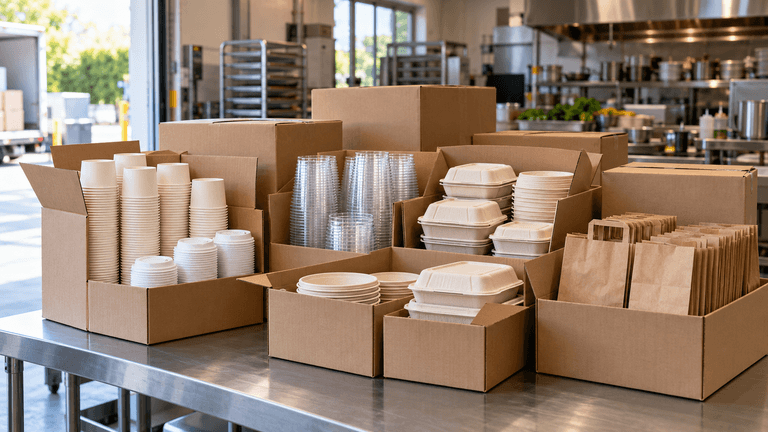
Bagasse foodware next to the paper and fiber items it usually ships with. The tan color is the natural fiber; bleached white bagasse exists too.

Key facts about bagasse
- Bagasse is roughly 30 percent of a sugarcane stalk by weight, so every ton of sugar leaves hundreds of pounds of fiber that would otherwise be burned or dumped.
- Finished bagasse foodware is made in about 2 to 3 hours of processing, from wet fiber to a sleeved case.
- Bagasse handles hot food to about 200 F, short microwave reheats, and freezer storage at 0 F.
- Bagasse is tested to ASTM D6868 and certified by BPI for commercial composting, where it breaks down in roughly 45 to 90 days.
- In California, fiber foodware including bagasse must contain no intentionally added PFAS and under 100 ppm total organic fluorine (AB 1200, since 2023).
- A 9 x 9 inch bagasse clamshell lists at about $47 to $80 per case of 200 on public wholesale sites, or 23 to 40 cents each.
Further reading
- Compostable vs. biodegradable vs. recyclable: what the labels legally mean in California
- BPI certified vs. OK compost HOME: which certification your foodware needs
What is bagasse?
Bagasse (pronounced buh-GAS) is the leftover fiber from sugarcane processing. Mills press the cane for juice, and what remains is a wet, stringy pulp that is mostly cellulose.
For most of the industry's history that bagasse was burned in the mill's boilers or left to rot. It is a byproduct, not a crop grown for packaging.
That matters for two reasons. First, it does not compete with food for farmland. Second, supply follows the sugar harvest, which is why molded fiber pricing moves with sugar seasons rather than with oil.
When you see "sugarcane fiber," "sugarcane pulp," or "molded fiber" on a spec sheet, it almost always means bagasse. Some molded fiber products blend it with bamboo or wheat straw, so ask if the fiber source matters to you.
It is also the material behind most of the compostable containers that Bay Area ordinances now require, which is why it deserves its own explainer.
How is bagasse made into packaging?
Turning bagasse into a food container is closer to papermaking than to plastics. There is no resin, no extrusion, and no lamination in a plain bagasse tray.

The bagasse process, from sugar mill leftover to a finished container.
- Crushing. Sugarcane is pressed for juice. The fiber left behind is bagasse.
- Cleaning. The bagasse is washed and screened to remove dirt, sugar residue, and short fines that would weaken the finished piece.
- Pulping. Clean bagasse is mixed with water into a slurry and refined to the fiber length the product needs. Bowls want longer fiber for stiffness; plates can use shorter.
- Molding. The slurry is drawn onto shaped screens and pressed. Heat and pressure drive out water and lock the fibers into a rigid three-dimensional shape.
- Drying and trimming. A second hot press smooths the surface and trims the flash. This is where a bagasse clamshell gets its lock tabs and a bowl gets its lid channel.
- Packing. Finished pieces are sleeved and cased, typically 200 to 1,000 per case depending on size.
Manufacturers describe the full cycle as about 2 to 3 hours from raw fiber to packed product. Grease resistance comes from how densely the pulp is pressed, not from a coating, which is why PFAS-free bagasse is now the norm.
Further reading
What is bagasse packaging used for?
Bagasse shows up wherever a food business needs a rigid, grease-tolerant container that can go into a compost stream. The common bagasse formats are:
- Hinged clamshells in 6 x 6, 8 x 8, 9 x 6, and 9 x 9 inches, with one or three compartments. The workhorse for entrees and combo plates.
- Bowls from 8 to 48 oz, with bagasse or PET lids. Grain bowls, soups, poke, and salads.
- Plates in 6, 7, 9, and 10 inches, round or square, plain or compartment. Catering and events.
- Trays for sushi, bakery, and produce, often paired with a clear PET or PLA lid. See our guide to sushi trays wholesale for the size ladder.
- Cups and lids for hot soup and sides, and molded bagasse lids that replace plastic on cups and bowls.

Bagasse sushi trays: the fiber base handles the moisture, the clear lid does the selling.
Bagasse is less common for cold cups and for anything a customer needs to see through. That is where PLA and PET still win, and where a fiber base with a clear lid is the usual compromise.
For a Bay Area operator the practical split is simple: bagasse for anything hot, greasy, or headed to a green bin; clear plastic only where visibility sells the product. Cups are their own decision; see the hot cups and cold cups collections.
Is bagasse compostable?
Yes, in a commercial facility. Bagasse is plant fiber, so it composts the way food-soiled paper does, and certified bagasse breaks down in roughly 45 to 90 days at industrial temperatures of 131 to 158 F.
The word to watch is "certified." An uncertified tray might still contain a coating or additive that fails the test, and a certificate is what your hauler and your city inspector will ask for. Look the number up on the BPI certified products database.

What each mark on a bagasse spec sheet actually certifies.
Three marks matter for bagasse in the United States:
- BPI Certified Compostable. The Biodegradable Products Institute is the certifier most Bay Area programs recognize. It tests fiber products to ASTM D6868 and plastics to ASTM D6400, and it requires PFAS below 100 ppm.
- ASTM D6868. The test standard for paper and molded fiber, including bagasse with a compostable coating. This is the standard behind almost every certified bagasse clamshell.
- TUV Austria OK compost HOME. The only common mark that means backyard conditions. Most bagasse foodware is certified for industrial composting only, which is fine for a restaurant and irrelevant for a home bin.
What it is not: "biodegradable." That word has no test standard and no timeline, and California restricts it on plastic products. Ask for the certificate number instead, and keep it on file for your health inspector.
Does bagasse go in the green bin in the Bay Area?
Usually, but it depends on the hauler, not on the product. Under SB 1383, every California business has to separate organics, and each jurisdiction decides which foodware its composter accepts. Recology's FAQ is blunt that plastic clamshells stay out of the green bin even when labeled compostable.
San Francisco's SF Approved list accepts BPI-certified fiber foodware in the green bin. Alameda County programs run by StopWaste accept food-soiled paper and fiber but discourage compostable plastics, so a bagasse bowl passes and its PLA lid may not.
If you operate in more than one city, the safe pattern is plain bagasse with no plastic lining and a fiber or paper lid. Our post on what to do when there is no composter near you covers the honest answer for cities without a program.
Further reading
- BPI certified vs. OK compost HOME
- ASTM D6868, the fiber compostability standard
- TUV Austria OK compost certification
Is bagasse microwave safe, freezer safe, and grease resistant?
Bagasse is the most forgiving fiber material on the market, which is why it replaced foam so quickly in California. The limits are still worth knowing.

The bagasse numbers that matter on the line and in the bin.
- Hot food. Bagasse holds hot food to about 200 F without softening. Some grades are rated for reheating in an oven; check the sheet before you promise it.
- Microwave. Short reheat cycles are fine. Long cycles dry the bagasse and it can scorch at the edges, so tell customers "reheat for a minute or two," not "bake."
- Freezer. Bagasse keeps its shape at 0 F, where PLA cracks and thin PET goes brittle. Freezer-to-microwave meal prep is a real bagasse use case.
- Grease and moisture. Dense pressing gives bagasse natural grease resistance for a normal service window. Very oily food sitting for hours will eventually wick through, which is why bagasse is a takeout container and not a storage container.
- Soak time. Soup in a bagasse bowl is fine for a delivery run of 30 to 60 minutes. Past that, use a bagasse bowl with a bagasse lid that seals, or a lined bowl.
One more spec to ask for: the PFAS statement. Older grease-resistant fiber relied on fluorinated coatings. Since January 1, 2023, AB 1200 bans intentionally added PFAS in plant-fiber foodware sold in California and caps total organic fluorine at 100 ppm. Any bagasse you buy for a California kitchen should say "no added PFAS" on the sheet.
Further reading
- Food packaging temperature limits by material (Restaurantware)
- California plastic labeling laws: SB 343 and AB 1201
How does bagasse compare to PLA, coated paper, and foam?
Most operators are not choosing bagasse in a vacuum. They are replacing foam, deciding between bagasse and PLA, or wondering whether a coated paper container is good enough.

Bagasse against the three materials it usually replaces.
Bagasse vs. PLA. PLA is a corn-based plastic. It is clear, which fiber can never be, but it softens above about 104 F and most Bay Area composters do not accept it even when certified. Bagasse takes heat, goes in the green bin, and costs less per piece. Use PLA for cold cups and lids; use fiber for everything else.
Bagasse vs. coated paper. A PE-coated paper container is neither recyclable nor compostable in practice, because the plastic lining fails both streams. Bagasse needs no lining. Paper wins only on print quality, which is why custom printed packaging is still mostly paper, and on very long soak times.
Bagasse vs. foam. This comparison is over in California. Under SB 54, expanded polystyrene foodware has been banned from sale since January 1, 2025 after producers missed the 25 percent recycling threshold. Bagasse is the direct replacement: same clamshell footprints, similar insulation, and no ban.
The honest weakness of bagasse is appearance over time. A clamshell that sits under a heat lamp for an hour will darken where the grease is. If presentation on a shelf matters more than the bin it ends up in, pair a fiber base with a clear lid.
What does bagasse cost per case?
Bagasse costs more than foam did and less than most people assume. Public wholesale listings in September 2026 put the common bagasse formats here:
- 9 x 9 inch hinged clamshell, 1 compartment: about $47 to $80 per case of 200, or 23 to 40 cents each, with the spread driven by wall thickness and certification. Example listing at $46.80 and a BPI-certified example at $80.
- 16 oz bagasse bowl: about $61 per case of 500, or 12 cents each, with a clear PET dome lid adding roughly 11 cents. Example listing.
- 9 inch bagasse plates: the cheapest bagasse format, sold in cases of 500 to 1,000. Pricing varies widely by weight, so compare grams per plate, not just the case price.
Two things move bagasse pricing more than the brand on the box. Case volume, because fiber is bulky and freight is a real share of the landed cost. And certification, because BPI testing is paid for by the manufacturer and shows up in the price.
Suppliers are consolidating too. The Amazing Packaging acquisition by Kelly Spicers changed pricing and lead times for a lot of Bay Area buyers this year, so re-quote your bagasse items even if you are happy with them.
Safra Distribution stocks bagasse clamshells, bowls, plates, and trays in our compostable collection on Cut+Dry, delivered on weekly routes from Fremont across six Bay Area counties. If you move more than 10 cases a month, ask for a quote at that volume rather than buying at list. The gap between list and program pricing on bagasse is usually larger than the gap between brands.
What California rules apply to bagasse foodware?
Bagasse is the easy material to keep compliant, but four rules still touch it:
- AB 1200 (PFAS). Since 2023, plant-fiber foodware sold in California must have no intentionally added PFAS and under 100 ppm total organic fluorine. Ask for the test report.
- SB 54 (foam ban and packaging producer responsibility). Foam foodware has been banned since 2025, and producers of all packaging are being pulled into a statewide program that rewards recyclable and compostable formats. Bagasse sits on the right side of it.
- SB 343 and AB 1201 (labels). "Compostable" claims must be backed by certification, and the chasing-arrows symbol is restricted. Bagasse can say compostable when it is certified; it cannot say recyclable.
- AB 1276 (accessories on request). Not about bagasse itself, but it changes what goes in the bag with it: cutlery, napkins, and condiments only when the customer asks. Our AB 1276 checklist covers the counter setup.
On top of state law, several Bay Area jurisdictions require fiber foodware outright. San Mateo County's ordinance is the strictest; our San Mateo County foodware guide walks through it, and bagasse is the material that satisfies it with the fewest exceptions.
Further reading
How do you choose a bagasse product?
A good bagasse buy comes down to six checks. Run them on the spec sheet before you order a pallet.

The right bagasse mix for most Bay Area kitchens: fiber base, fiber lid, clear lid only where it sells.
- Certification number. A BPI certificate you can look up, not just a leaf logo.
- PFAS statement. "No added PFAS" and a fluorine test under 100 ppm.
- Weight per piece. Heavier bagasse is stiffer and holds heat longer. Compare grams, not just dimensions.
- Lid match. Buy the bagasse lid from the same line, or verify the PET lid snaps on the same rim. Mixed lines leak.
- Hauler acceptance. Confirm with your city or hauler that fiber foodware goes in the green bin before you print "compostable" on the menu.
- Storage. Bagasse absorbs humidity. Keep cases sealed, off the floor, and away from the dish pit.
Most operators end up with three bagasse items: one clamshell size, one bowl size with a matching lid, and one plate for catering. Add a tray only if you sell sushi, bakery, or produce. If you are sizing bowls, our 32 oz vs. 48 oz container guide has the fill numbers.
Final thoughts
Bagasse is not a trend. It is sugar mill leftover that happens to make a better takeout container than foam ever did, and California law has spent the last four years clearing its competitors out of the way.
If you are switching, start with the clamshell you use most, get the certificate and the PFAS sheet, and confirm your hauler takes fiber. Then price it at volume. Bagasse bought by the pallet from a local distributor is usually within a few cents of what the foam cost.
Questions about a specific bagasse product or a mixed order for several locations? Send us what you use today and we will match it line by line.
Further reading
Related posts
 Food Containers
Sysco Alternatives for Foodservice Packaging and Disposables
Compare Sysco alternatives for cups, lids, containers, and bags: broadliners, cash and carry, online, and local Bay Area packaging distributors.
Safra13 min read Food Containers
Compostable Hot Cups Wholesale
Compostable hot cups wholesale for Bay Area cafes: PLA-lined sizes, BPI and PFAS notes, lids, case packs, and Safra delivery.
Safra13 min read Food Containers
Imperial Dade Is Now Imperial Brady: What It Means for Your Packaging Supply
Imperial Dade is now Imperial Brady after the BradyPLUS merger. What Bay Area packaging buyers should check on invoices, accounts, and local supply options.
Safra11 min read