
Wholesale Bagasse Packaging: Trays, Bowls and Containers
Every bagasse format that ships by the case, what it costs wholesale in September 2026, the three ways to buy it, and how to size a first order.
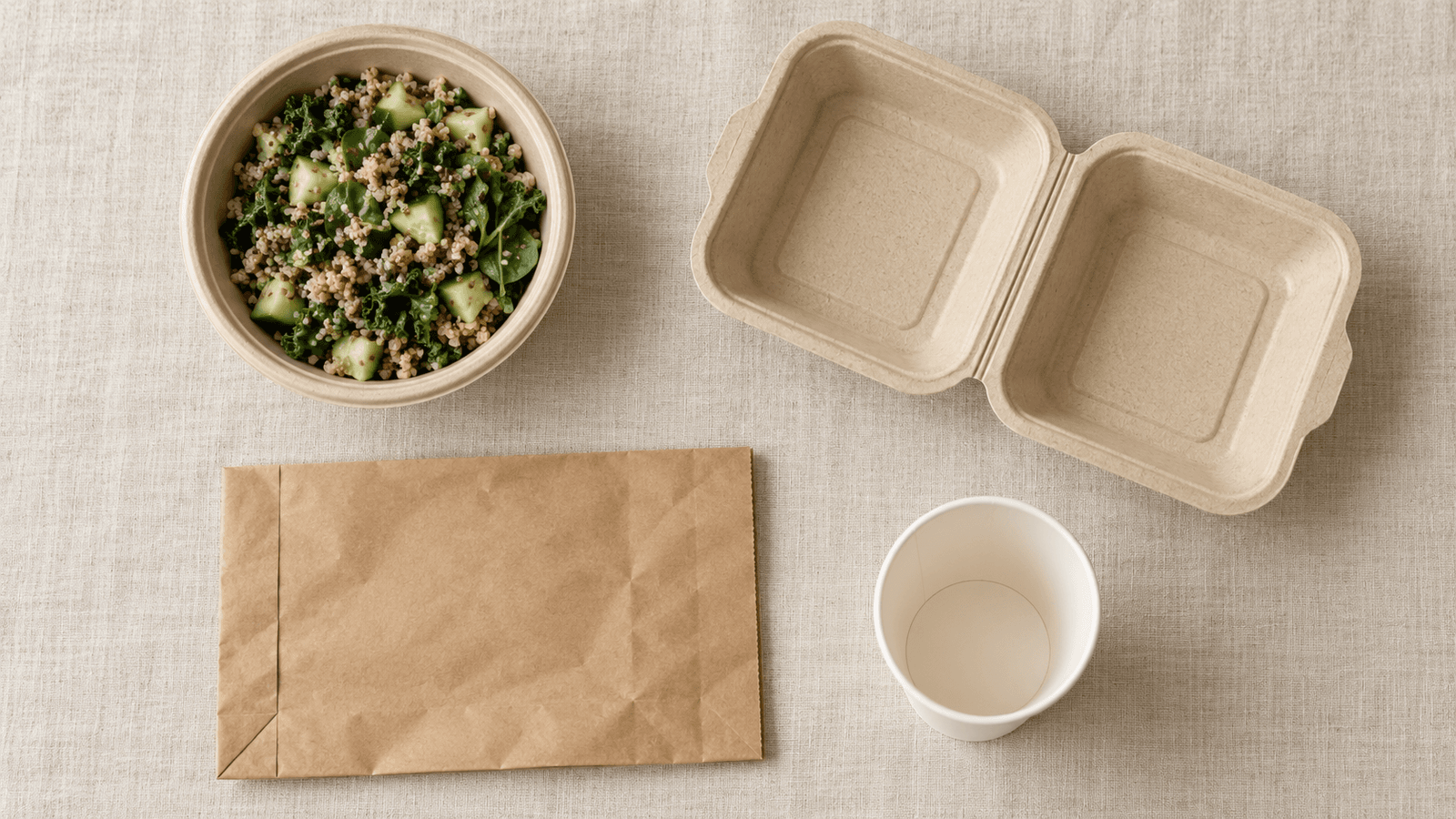
Wholesale bagasse packaging is sugarcane fiber foodware, meaning bagasse trays, bagasse bowls, bagasse containers, and bagasse plates, bought by the case or the pallet from a distributor or a factory instead of by the sleeve from a cash and carry.
This guide is the buying companion to our explainer on what bagasse is. It covers every bagasse format that ships by the case, what each one costs at wholesale in September 2026, the three ways to buy it, and how a Bay Area food business should size a first order.

A typical wholesale bagasse packaging mix for a Bay Area kitchen: hinged containers, bowls with lids, and trays from one fiber line.
Key facts about wholesale bagasse packaging
- Bagasse packaging ships in cases of 200 (hinged containers), 300 (bowls and trays), and 500 to 1,000 (plates), so one case is a real week of service for most counters.
- Public wholesale listings put a 9 x 9 inch bagasse hinged container at 21 to 27 cents, a 32 oz bagasse bowl at 15 to 44 cents, and a 9 inch bagasse plate at 8 to 11 cents.
- Factory direct bagasse orders start at 30 to 200 cartons per item and take 15 to 25 days to make before ocean freight. A local distributor sells one case from stock.
- Fiber foodware sold in California must have no intentionally added PFAS and under 100 ppm total organic fluorine (AB 1200, since 2023), so the test report is part of the wholesale spec.
- Foam foodware has been banned from sale in California since January 1, 2025, which is why wholesale bagasse packaging demand jumped in the Bay Area.
Further reading
- What is bagasse? The sugarcane packaging material explained
- Compostable vs. biodegradable vs. recyclable: what the labels legally mean in California
What counts as bagasse packaging?
Bagasse packaging is any foodware molded from the fiber left after sugarcane is pressed for juice. In a wholesale catalog it shows up under five names: bagasse trays, bagasse bowls, bagasse hinged containers, bagasse rectangular containers, and bagasse plates.
Spec sheets also call it "sugarcane fiber," "molded fiber," or "pulp." Some blends add bamboo, so ask for the fiber source if it matters to your menu.

The bagasse packaging formats that ship by the case, with the sizes and case packs in our compostable catalog.
The formats that matter for a takeout or catering operation:
- Bagasse trays. 8 and 9 inch food trays with one or three compartments, sushi tray and lid combos, meat and produce trays, and 14 x 18 inch catering platters.
- Bagasse bowls. Round, square, poke, burrito, and rice bowls from 16 to 48 oz, plus catering bowls at 160 and 240 oz.
- Bagasse hinged containers. The clamshell that replaced foam: 6 x 6, 8 x 8, 9 x 6, and 9 x 9 inches, one to three compartments, and taco boxes.
- Bagasse rectangular containers. 9 x 6 inch bases from 16 to 54 oz with shallow, dome, or fiber lids, the meal prep and entree workhorse.
- Bagasse plates. Round 6 to 10 inch and oval 10 and 12 inch, the cheapest bagasse piece and the one catering buys most.
Everything above is in the Safra compostable collection catalog as the Planet Choice fiber line, with World Centric, Fineline, and DEP items filling the gaps. Live case pricing is on our Cut+Dry catalog once you sign in.
Which bagasse trays should a food business stock?
Bagasse trays are the format buyers underestimate. A bagasse tray with a clear anti-fog lid replaces a plastic deli container at a lower cost per piece, and the base goes in the green bin.
Three bagasse tray families cover most menus:
- 9 and 8 inch bagasse food trays. One or three compartments, 300 per case, with a matching fiber lid or a clear PET lid. The 9 inch three compartment tray is the plate lunch and combo box; the 8 inch fits a single entree with a side.
- Bagasse sushi trays. Six sizes from 6.6 x 4.7 inches to 9.1 x 4.8 inches, sold as tray and clear lid combos, 300 per case. Our sushi trays wholesale guide walks the size ladder and where fiber beats PET.
- Bagasse catering trays. 14 x 18 inch fiber platters, 100 per case, with a clear dome lid sold separately, 50 per case. Public listings run $129 to $136 per case, or about $1.30 each.

Bagasse sushi trays in three sizes. The fiber base absorbs moisture; the clear lid does the selling.
One tray spec to check before you commit a case: the lid. Trays from one factory rarely fit lids from another. Buy the tray and lid as a combo, or buy both from the same line, and test the snap on a sample before the first pallet.
Further reading
- Sushi trays wholesale: bulk options for takeout and retail
- AB 1276 checklist: accessories and condiments on request only
Which bagasse bowls come by the case?
Bagasse bowls are the fastest growing bagasse format because grain bowls, poke, and salads moved from plastic to fiber faster than any other menu category. The bowl decision is really a shape decision, then a lid decision.
- Round bowls, 24 and 32 oz. 8 inch diameter, 300 per case. Soup, ramen, curry, and anything a customer eats with a spoon. A fiber lid fits the 24 and 32; a clear anti-fog PET lid fits 24 through 48 oz.
- Square bowls, 8.5 inch, 24 to 48 oz. The grain bowl and salad standard, 300 per case, one clear lid across all three depths. The 48 oz square bowl is the family salad and the meal prep base.
- Poke bowls, 7 inch, 16 to 32 oz. Same square shape, smaller footprint, 300 per case, one lid across all three. Sized for a single serving with a compact bag.
- Burrito bowls, 18 and 32 oz. Oval, 300 to 400 per case, with a PLA lid. Built for a heavy fill with a lid that seals.
- Rice bowls, 16 oz. 1,000 per case, no lid, the lowest cost bowl for dine in and buffet service.
If you sell by volume, our 32 oz vs. 48 oz round container guide has the fill weights that decide between the two most common bagasse bowl sizes.
Lid pricing is the hidden line on a bagasse bowl order. A clear PET lid adds roughly 10 to 15 cents per bowl on public listings, so a 25 cent bowl becomes a 35 to 40 cent bowl with the lid.
A fiber lid keeps the whole package in the green bin, which matters in cities where the hauler rejects PET.
Further reading
- 32 oz vs. 48 oz round containers: which size to stock
- BPI certified vs. OK compost HOME: which certification your foodware needs
Which bagasse containers replace foam clamshells?
Bagasse hinged containers are the reason most Bay Area operators buy bagasse at all. When SB 54 ended foam foodware sales in California on January 1, 2025, the bagasse clamshell took over the same footprints.
The bagasse container sizes that map onto the old foam sizes:
- 9 x 9 inch bagasse hinged container. One or three compartments, 200 per case. The entree box and the combo plate. A PLA laminated version exists for wet or saucy food.
- 8 x 8 inch hinged container. One compartment or three shallow compartments, 200 per case. Sandwich plates, small entrees, and dessert.
- 9 x 6 inch hoagie box. One or two compartments, 250 per case. Sandwiches, wraps, burritos, and a side.
- 6 x 6 inch burger box. 500 per case, in a standard and a Euro style. Burgers, sliders, and pastries.
- Taco box. Two or three compartments, 300 per case, sized for two or three tacos and a side.

Bagasse hinged containers and bowls, the two formats that replaced foam in most Bay Area kitchens.
Bagasse rectangular containers are the other half of the container category. The 9 x 6 inch base comes in 16, 24, 30, 32, 48, and 54 oz depths, 300 to 400 per case.
One shallow lid, one dome lid, and one fiber lid cover the 16 to 48 oz range. That lid sharing is what makes rectangular containers cheap to stock across a whole menu.
Bagasse plates round out the container order: round 6 to 10 inch plates at 500 or 1,000 per case, and 10 and 12 inch ovals at 500. Compare grams per plate, not just the case price; a heavier plate is stiffer.
Further reading
- SB 54 packaging law in plain English for food businesses
- CalRecycle: expanded polystyrene food service ware requirements
How much does bagasse packaging cost wholesale?
Bagasse packaging costs more than foam did and less than most first time buyers expect. Public wholesale listings in September 2026 put the common bagasse formats here:

Public case prices for the five most ordered bagasse packaging formats. Program pricing at volume runs below these.
- 9 x 9 inch bagasse hinged container, 3 compartment: $43 to $54 per case of 200, or 21 to 27 cents each. A no added PFAS listing at $42.99 and a $53.95 list price marked down to $45.85 bracket the range.
- 32 oz round bagasse bowl: $46 to $132 per case of 300, or 15 to 44 cents each. An uncertified import listing sits at the bottom and a BPI certified Fineline bowl at the top. No other bagasse format spreads this wide.
- 24 oz square bagasse bowl: about $75 per case of 300, or 25 cents each, lid extra.
- 9 inch round bagasse plate: $38 to $55 per case of 500, or 8 to 11 cents each. A no added PFAS fiber plate at $37.99 and a bagasse plate at $54.99 set the ends.
- 14 x 18 inch bagasse catering tray: $129 to $136 per case of 100, or about $1.30 each, with the dome lid adding roughly the same again.
Three things move a bagasse packaging price more than the brand on the case. Certification, because BPI testing is paid for by the manufacturer and shows up per piece. Weight, because a heavier clamshell uses more fiber. And freight, because bagasse is bulky for its weight and a case of 200 clamshells takes real truck space.
Those are list prices. A distributor program at 10 or more cases a month usually lands below them, and the gap between list and program pricing on bagasse is normally larger than the gap between brands.
Supplier consolidation matters too. The Amazing Packaging move into Kelly Spicers reset a lot of Bay Area bagasse quotes this year, so re-quote even the items you are happy with.
We do not publish a public price list. Sign in to the Cut+Dry catalog for live case prices, or send us your current bagasse list and we will quote it line by line at your volume.
Where do you buy bagasse packaging wholesale: factory, broadline, or local distributor?
There are three ways to buy bagasse packaging wholesale, and the right one depends on volume, cash, and how much of the supply chain you want to run yourself.

Factory direct, national broadline, and local distributor, compared on the questions a Bay Area buyer actually asks.
Factory direct. Search "bagasse packaging wholesale" and the results are almost all offshore manufacturers. Their terms are honest but heavy: minimums of 30 to 200 cartons per item, often 50,000 pieces per SKU at a certified bagasse tray factory, 15 to 25 days of production, then ocean freight, customs, and a warehouse to receive it.
That is the right channel for a private label line at very high volume, and the wrong one for a three location cafe group.
National broadline. Food distributors carry a bagasse range alongside food. The convenience is one truck; the cost is a narrow bagasse selection, order minimums per delivery, and certification paperwork on request rather than on file.
Local distributor. A packaging distributor like Safra buys bagasse by the container, holds it in Fremont, and sells it by the case on a weekly route across six Bay Area counties. Minimum is one case, samples ride the next delivery, and the BPI certificate and PFAS report for each SKU are on file before you ask.
Most operators use a local distributor for the bagasse mix and go factory direct only when one item crosses a container load a year. Custom printed packaging bridges the two: a print run on a stock item, at far less than a private mold.
Further reading
- MOQ, lead time, and shipping guide for eco packaging buyers in 2026
- Wholesale biodegradable food containers: MOQ, lead time, and bulk order planning
- Amazing Packaging is now part of Kelly Spicers: what Bay Area buyers should know
What certifications and California rules apply to wholesale bagasse packaging?
Bagasse is the easiest foodware material to keep compliant in California. A wholesale bagasse order still needs four things in the folder.
- BPI certificate. Bagasse foodware is tested to ASTM D6868 and certified by the Biodegradable Products Institute. Look the number up in the BPI certified products database before the first case lands.
- PFAS test report. AB 1200 bans intentionally added PFAS in plant fiber foodware sold in California and caps total organic fluorine at 100 ppm. Every SKU should ship with a report under that line.
- Labeling compliance. SB 343 and AB 1201 restrict "compostable" and "recyclable" claims. Certified bagasse can say compostable; nothing bagasse should say recyclable.
- Hauler acceptance. SB 1383 makes organics separation mandatory, but each jurisdiction decides which foodware its composter takes. SF Approved and StopWaste both accept certified fiber; confirm before you print "compostable" on the menu.

The BPI mark is the one most Bay Area haulers and inspectors look for on bagasse packaging.
Local ordinances stack on top. San Mateo County requires fiber foodware outright for most takeout, and bagasse is the material that satisfies it with the fewest exceptions. No commercial composter in your city? Read our honest answer on compostable packaging first.
Further reading
- California plastic labeling laws: SB 343 and AB 1201
- CalRecycle: accurate recycling labels
- San Mateo County foodware ordinance explained
How do you size and store a wholesale bagasse packaging order?
Bagasse is bulky, absorbs humidity, and ships in big case counts, so the order size question is really a storage question.

The numbers to plan a bagasse packaging order around.
- Count a week of service per format. A counter doing 150 entrees a day uses about a case of 9 x 9 bagasse containers every day and a half, and a case of 300 bagasse bowls every two days at 150 bowls a day.
- Order two weeks, deliver weekly. With a weekly route you never need more than two weeks of bagasse on the floor. That is usually six to ten cases across trays, bowls, and containers for a single location.
- Keep cases sealed and off the floor. Bagasse takes on moisture from a dish pit or a wet walk in. Store it dry, on a shelf, and open one case at a time.
How do you choose a wholesale bagasse packaging supplier?
Run these six checks on any bagasse supplier before the first pallet, whether it is a factory, a broadliner, or us.

The six checks for a bagasse packaging order, from certification to storage.
- Certificate on file, per SKU. A BPI number you can look up for every item, not a leaf logo on the case.
- PFAS report on request. Total organic fluorine under 100 ppm, dated within the last year.
- Samples before pallets. A tray, bowl, and container with their lids, in your kitchen, filled with your food, before you commit a case count.
- Stated lead time. Weekly from stock, or 15 to 25 days plus a boat. Either is fine if it is written down.
- Mixed cases on one order. Trays, bowls, and containers together, plus the paper bags and cups that ship with them.
- A price at your volume. A quote for what you actually use per month, not a list price, and a re-quote when a supplier changes hands.
Safra Distribution stocks the full Planet Choice bagasse line plus World Centric and Fineline fiber in Fremont, and delivers weekly across the Bay Area. Read about us or go straight to becoming a customer.
Final thoughts
Wholesale bagasse packaging is a solved problem for the Bay Area. The formats are standard, the prices are public within a range, the rules are clear, and foam is gone. What separates a good bagasse program from an expensive one is the supplier: paperwork on file, samples before pallets, one case minimum, and a price at your real volume.
Start with the three items you use most, usually one hinged container, one bowl with a lid, and one plate or tray. Get the certificate and the PFAS report, confirm your hauler takes fiber, and then quote it at volume. Bagasse bought by the case from a local distributor is usually within a few cents of what the foam cost, without the ban.
Ready to price a bagasse order for one location or ten? Send us what you buy today and we will match it line by line, or browse the compostable collection on Cut+Dry.
Further reading
Related posts
 Food Containers
What Is Bagasse? The Sugarcane Packaging Material Explained
Bagasse is the fiber left after sugarcane is pressed for juice. Here is how it becomes food packaging, what it can do, what it costs, and the rules.
Safra13 min read Food Containers
Sushi Trays Wholesale: Bulk Options for Takeout and Retail
Which sushi tray sizes to stock, what PET, OPS, and fiber trays cost per case, and the two California rules that change what goes in the bag.
Safra7 min read Food Containers
Amazing Packaging San Jose: What Happened? | Safra
Amazing Packaging was acquired by Kelly Spicers in 2026. Here's what Bay Area buyers should check before their next packaging order.
Safra4 min read