
Food-Safe Kraft Paper Bags: Wholesale Foodservice Bags
Food safe paper bags for kitchens: FDA paper rules, PFAS-free grease barriers, Bay Area bag laws, and how to buy kraft paper bags wholesale.
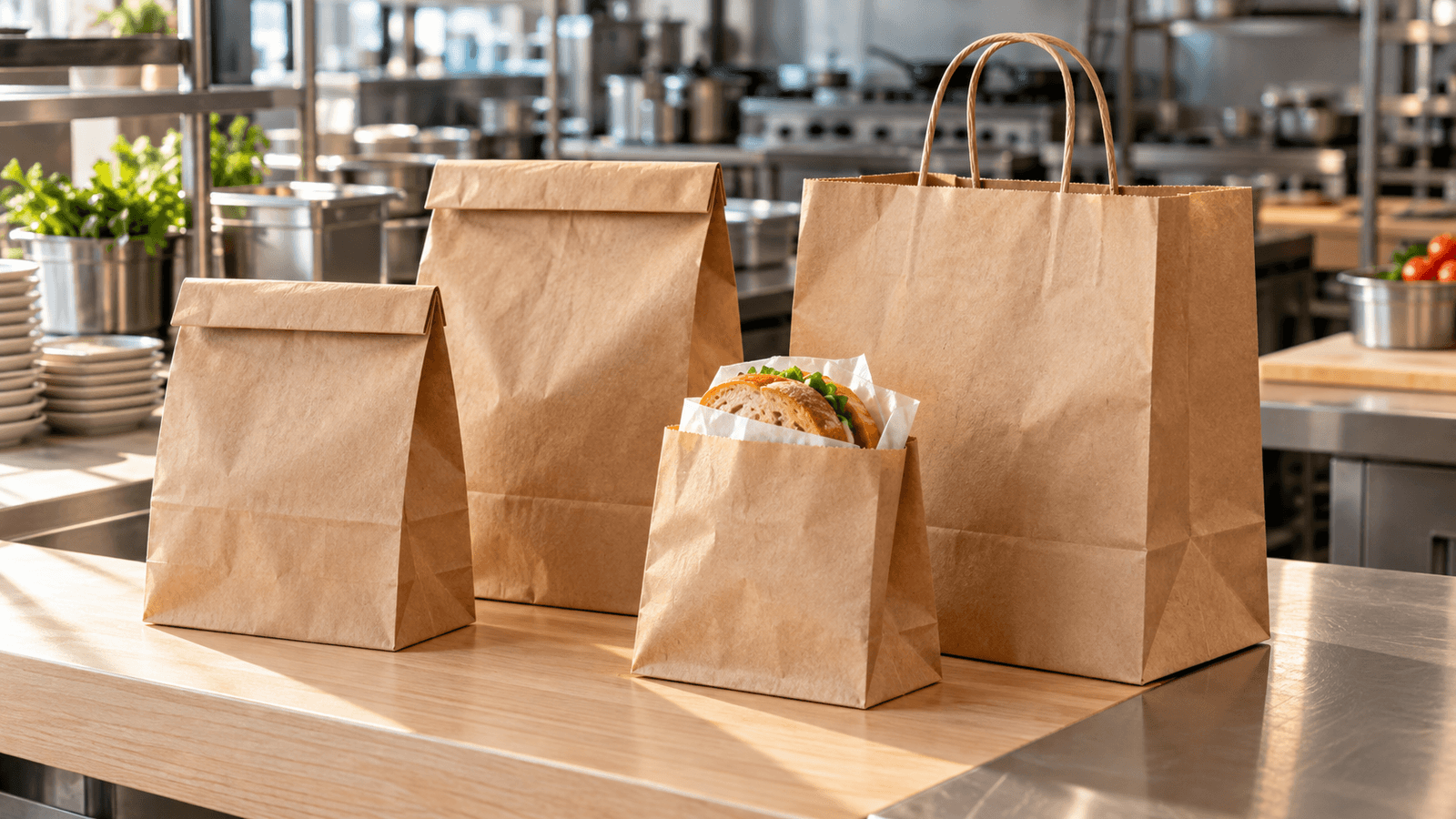
Friday lunch, 40 tickets on the rail. The fries soak through a plain kraft bag before the driver arrives, and an inspector asks what your sandwich bags are made of. Paper bags look interchangeable on a shelf. On a busy line they are not.
Food safe paper bags are kraft or white paper bags made with materials cleared for direct food contact under FDA rules, sold wholesale by the case to restaurants, cafes, bakeries, and caterers for takeout, sandwiches, pastries, and delivery.
This guide covers foodservice paper bags from the food-safety side: FDA rules, PFAS-free grease resistance, California and Bay Area bag rules, and buying kraft paper bags wholesale. For trade sizes and basis weights, see how to choose brown paper bags.
Key facts about food safe paper bags before you order:
- The FDA covers the food-contact surface of paper under 21 CFR 176.170 for aqueous and fatty foods and 21 CFR 176.180 for dry foods. For fatty and aqueous foods, 176.170 caps chloroform-soluble extractives at 0.5 milligram per square inch of food-contact surface.
- California AB 1200 has banned plant-fiber food packaging with intentionally added PFAS, or 100 ppm or more total organic fluorine, since January 1, 2023. Paper and paperboard count, so food safe paper bags sold in California must be PFAS-free.
- The FDA announced on February 28, 2024 that PFAS grease-proofing agents are no longer sold for US food packaging paper, with a June 30, 2025 compliance date to clear old stock.
- Under SB 1053, covered stores have handed out only recycled paper bags at checkout since January 1, 2026, for at least $0.10 each, with 50 percent postconsumer content required from January 1, 2028.
- Case counts for foodservice paper bags vary widely: about 400 to 500 per bundle for SOS bags, 250 per case for many handled takeout bags, 2,000 per case for dry wax sandwich bags, and 8,000 per carton for some glassine bakery bags.
- Safra Distribution in Fremont stocks food safe paper bags with to-go boxes and compostable lines, on weekly Bay Area routes with one-case minimums on many items.
What types of foodservice paper bags does a kitchen need?
Most kitchens run four to six foodservice paper bags, each matched to a job. One bag for everything means soggy fries and crushed pastries.

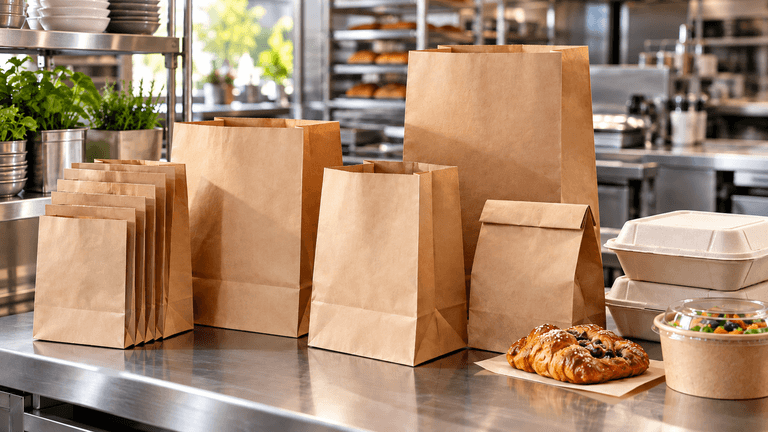
A typical lineup of foodservice paper bags, from flat sandwich bags to large kraft SOS takeout bags.
The common types of food safe paper bags:
- SOS takeout paper bags. Self-opening, flat-bottom kraft bags with no handles. They stand open on the pass for fast packing and come in trade sizes from about #2 to #25.
- Handled carryout paper bags. Twisted or flat paper handles for delivery, catering pickup, and longer walks. A common takeout size is about 10 x 6.75 x 12 in, often 250 per case.
- Sandwich and deli paper bags. Flat or lightly gusseted bags in dry wax or grease-resistant paper. Bagcraft's 300411 dry wax sandwich bag is 6 x 3/4 x 6 1/2 in, packed 2,000 per case.
- Bakery and pastry paper bags. Glassine or grease-resistant bags for croissants, cookies, and donuts. One Bagcraft glassine bag is 5 3/4 x 7 3/4 in, sold 1,000 per pack, 8 packs per carton.
- Window and coffee paper bags. Clear-front kraft bags for cookies and retail beans.
- Custom printed paper bags. Your logo on SOS or handled kraft, which turns every delivery into an ad.
A sandwich shop may need only three foodservice paper bags. A bakery cafe with delivery may need six.
Further reading on paper bags and packaging basics
- How to choose brown paper bags: sizes, weights, and bulk pricing
- Custom printed paper bags from Safra
What makes paper bags food safe?
Food safe paper bags are not a marketing label. They are paper bags whose food-contact surface uses only substances the FDA allows for food contact.
What the federal rules cover:
- The paper itself. 21 CFR 176.170 lists the substances allowed in the coated or uncoated food-contact surface of paper that touches aqueous and fatty foods. It sorts foods into nine types.
- Dry foods. 21 CFR 176.180 covers paper in contact with dry food with no free fat or oil on the surface, such as bread rolls or bagged chips.
- Glue on the seams. 21 CFR 175.105 limits adhesives that can touch food to trace amounts at seams and edges for fatty and aqueous foods.
- Inks. Print belongs on the outside. Ask the maker to confirm nothing printed sits on the food-contact side.
The practical test is paperwork: a manufacturer statement that the paper and adhesives meet FDA food-contact rules for your use. Duro, for example, describes its Bulwark SOS bags as made from FDA compliant paper for food contact. Online sellers such as ClearBags provide FDA certificates and spec sheets by item number on request.
No statement? Treat those paper bags as retail bags and wrap food before it goes in.
Are recycled kraft paper bags food safe, or do you need virgin fiber?
Both can be food safe paper bags. Documentation decides, not fiber alone.
What the rule says:
- 21 CFR 176.260 allows pulp from reclaimed fiber in food packaging, as long as the source paper did not carry poisonous or harmful substances that could migrate into food.
- Virgin kraft avoids that question entirely. Duro's Bulwark SOS line is extra-heavy-duty virgin kraft, packed 400 per bundle.
- Recycled lines can carry food-contact claims too. Duro's Dubl Life SOS paper bags are 100 percent recycled paper with at least 60 percent postconsumer content, described by sellers as FDA approved for food contact and BPI certified, packed 500 per bundle.
How to choose between them:
- Unwrapped food. Pastries and fries touch the paper. Get the food-contact statement, and consider virgin or grease-resistant paper.
- Food in containers. The bag is secondary packaging, so recycled kraft paper bags work well.
- Carryout under local law. Some Bay Area rules require 40 percent postconsumer content, so recycled is often the compliant choice.
Further reading on materials and labels
- Compostable vs biodegradable vs recyclable: what the labels mean in California
- BPI certified vs OK Compost HOME
How do grease resistant paper bags work without PFAS?
Grease is the main way foodservice paper bags fail. Many grease-resistant papers once used PFAS coatings. That path is closed.
Two dates matter:
- February 28, 2024. The FDA announced that PFAS grease-proofing substances are no longer sold for food contact use in the US market.
- January 6, 2025. The FDA declared 35 food contact notifications for PFAS grease-proofers no longer effective, with June 30, 2025 set to clear existing paper stock.

Grease resistant food safe paper bags hold a hot pastry and fries without spotting through.
How fluorochemical-free paper bags resist grease today:
- Dense grease-resistant paper. Pulp pressed tighter leaves less room for oil. ClearBags uses 40 gsm PFAS-free grease-resistant paper for bakery bags.
- Glassine. Smooth, dense, translucent paper for cookies and pastries.
- Dry wax. Adds moisture resistance and wet strength to sandwich and deli paper bags.
- Clay or mineral coatings. Slow oil and give a cleaner print surface.
- A liner. Put the oily item in a fiber tray or clamshell and let the kraft bag carry it.
Match the barrier to the food:
- Fries and fried chicken: grease-resistant or dry wax bags.
- Croissants and cookies: glassine or grease-resistant bakery paper bags.
- Soups and saucy entrees: a sealed container inside a kraft SOS bag.
Ask for a PFAS statement or total organic fluorine result on each grease-resistant SKU. Under AB 1200, that is your proof.
Further reading on PFAS-free containers
How do California rules apply to food safe paper bags?
California regulates paper bags two ways: chemistry, and who hands out which bag.
AB 1200: PFAS in plant-fiber food packaging.
- Covers packaging made in substantial part of paper, paperboard, or other plant fiber, including wrappers and liners.
- Since January 1, 2023, no one may sell or distribute that packaging with intentionally added PFAS or 100 ppm or more total organic fluorine.
- The California Attorney General's enforcement advisory says it applies to shops and restaurants selling take-out food, not just manufacturers.
SB 1053: carryout bags at covered stores.
- Applies to grocery stores, retail stores with a pharmacy, convenience stores, food marts, and liquor stores, per CalRecycle.
- Since January 1, 2026, those stores may give out only recycled paper carryout bags at checkout, for at least $0.10 each.
- Bags must print the manufacturer name, country of manufacture, and postconsumer content percentage. From January 1, 2028, they need at least 50 percent postconsumer content.
For a kitchen, AB 1200 applies to every food safe paper bag you hand out. SB 1053 mostly applies to stores. See our California paper bag law guide and SB 54 for food businesses.
Which Bay Area paper bag rules apply to restaurants?
Local bag ordinances adopted before 2014 still shape restaurant paper bags in parts of the Bay Area. San Francisco says its own law, not SB 1053, governs bags there.
- San Francisco. Restaurants must use compliant checkout bags for takeout and delivery, including paper bags labeled with 40 percent postconsumer recycled content, and charge at least 25 cents per bag, shown separately on the receipt. No charge applies to a doggy bag from sit-down dining under the city code.
- Alameda County. Under the StopWaste ordinance, eating establishments may give paper bags free but must charge at least 10 cents for thick reusable plastic bags. The ordinance text sets recycled paper bags at 40 percent postconsumer content, no old-growth fiber, and printed labeling.
- San Mateo County. Foodware rules cover fiber-based and PFAS-free takeout items. See the San Mateo County foodware ordinance explained.
A simple Bay Area rule: buy carryout paper bags with at least 40 percent postconsumer content and printed content marks.
Further reading on Bay Area rules
How do you size foodservice paper bags to your menu and containers?
Size foodservice paper bags to your containers, not a size chart. Too small tears; too big lets containers tip.
A quick method:
- List your top 10 tickets and the containers in each.
- Measure the footprint. The bag bottom should match or slightly exceed the containers laid flat.
- Check the height. Leave 2 to 3 inches above the tallest item for the fold.
- Test with real orders and watch for tears, tipping, and double-bagging.
Common pairings that work:
- Single sandwich or bagel: flat sandwich bag or a 4# SOS, about 5 x 3.12 x 9.75 in.
- Sandwich plus side: 6# to 8# SOS.
- Two containers or a 32 oz round container plus a drink: 12# SOS, about 7 x 4.5 x 13.75 in.
- Family meals and catering: handled kraft paper bags around 13 x 7 x 13 in, or larger.
- Sushi trays: a flat-bottom bag that keeps the tray level. See sushi trays wholesale.
Most kitchens land on two SOS sizes, one handled size, and one specialty bag for sandwiches or pastries.
How do you buy kraft paper bags wholesale without running out?
Buying kraft paper bags wholesale is a storage and reorder problem as much as a price one.

Kraft paper bags wholesale cases shelved off the floor, away from heat and moisture, in a cafe back room.
Know your pack counts:
- SOS bags usually ship in bundles of 400 to 500.
- Handled takeout paper bags often pack 200 to 250 per case.
- Sandwich and dry wax bags often pack 1,000 to 2,000 per case.
- Glassine bakery bags can pack 8,000 per carton.
Store kraft paper bags so they stay food safe:
- Off the floor. Health and Safety Code 114178 wants single-use articles stored at least 6 inches up in a clean, dry spot.
- Dry. Moisture weakens kraft fiber and seams. Keep paper bags away from the dish pit.
- Cool. Heat can soften wax coatings. Avoid ovens and fryers.
- Clean. Away from chemicals, with opened bundles covered.
- Rotated. Oldest case first.
Set a reorder point:
- Count bags used per day for each size over two weeks.
- Multiply by the days between deliveries, then add one extra week as safety stock.
- Reorder when your on-hand count drops to that number.
Example: if you use 150 12# bags a day with weekly delivery, you need about 1,050 bags per week plus 1,050 safety stock. Reorder at about 2,100 bags, roughly four to five bundles of 500.
Ask for a quote at this volume; case pricing moves with size and order volume. Compare quotes on cost per bag, since a 400-count and a 500-count bundle are different buys.
Why buy food safe paper bags from Safra Distribution?
Safra Distribution is a family-owned food packaging distributor in Fremont, CA, built for Bay Area kitchens that want foodservice paper bags and the rest of their packaging on one route.
What you get:
- Local stock. Everything ships from Safra's own Fremont warehouse, with no third-party fulfillment, per our service areas page.
- Weekly delivery in six counties. San Francisco, San Mateo, Santa Clara, Alameda, Contra Costa, and Santa Cruz, with order cutoff at end of business the day before your route day.
- One-case minimums on many items. Try a new grease-resistant bag without a pallet commitment.
- Samples on the next delivery. Test paper bags with your real tickets before you change the order guide.
- Paper bags plus the rest of the order. Kraft SOS and handled paper bags ride with to-go boxes, compostable hot cups, cold cups, and Planet Choice bagasse.
- PFAS and BPI paperwork. PFAS-free and BPI-certified compostable lines, with certificates on file.
- Custom printed paper bags. A proof and firm quote before production, with stock held in Fremont. See custom packaging.
Safra is not a food distributor. Many kitchens keep a broadliner for food and use Safra for packaging, as our Sysco alternatives guide explains.
Further reading on Safra packaging lines
Food safe paper bags FAQ
Are plain brown paper bags food safe?
Not automatically. Kraft paper bags are food safe when the maker confirms the paper and adhesives meet FDA food-contact rules. Ask before unwrapped food goes in.
Are grease resistant paper bags PFAS-free?
In California they must be under AB 1200, and the FDA says PFAS grease-proofers are no longer sold. Still, ask for a PFAS statement per SKU.
Do restaurants have to charge for paper bags in the Bay Area?
It depends on the city. San Francisco requires at least 25 cents per checkout bag, including takeout. Alameda County eating establishments may give paper bags free.
Are food safe paper bags compostable?
Clean kraft paper bags are usually recyclable, and some are BPI certified compostable. Do not print a compostable claim unless the exact SKU is certified.
Final thoughts
Food safe paper bags come down to three checks: FDA food-contact paperwork, a PFAS-free grease barrier matched to the food, and recycled content that fits your city. Then size foodservice paper bags to your containers and store wholesale stock dry and off the floor.
Safra Distribution stocks food safe paper bags in Fremont, with weekly routes across six Bay Area counties, one-case minimums on many items, samples on the next delivery, and custom printed paper bags. Ask for a quote at your volume through /become-a-customer, usually answered within one business day, or browse the paper bags collection in the Safra catalog on Cut+Dry.
Further reading
Related posts
 Paper Bags
How to Choose Brown Paper Bags for Your Business: Sizes, Weights and Bulk Pricing
Choose brown paper bags by size, basis weight, and bulk case pricing for Bay Area takeout, bakery, and checkout programs.
Safra14 min read Paper Bags
California Paper Bag Law: What Changed in 2026 and What Comes in 2028
SB 1053 ended plastic checkout bags in California. Here is what stores must do now and before the 2028 recycled content deadline.
Safra4 min read