
What Is Greaseproof Paper? The Food Wrap and Liner Paper Explained
Greaseproof paper is dense paper that resists oil without a coating. Here is how it is made, sizes, PFAS rules, compost, and cost.
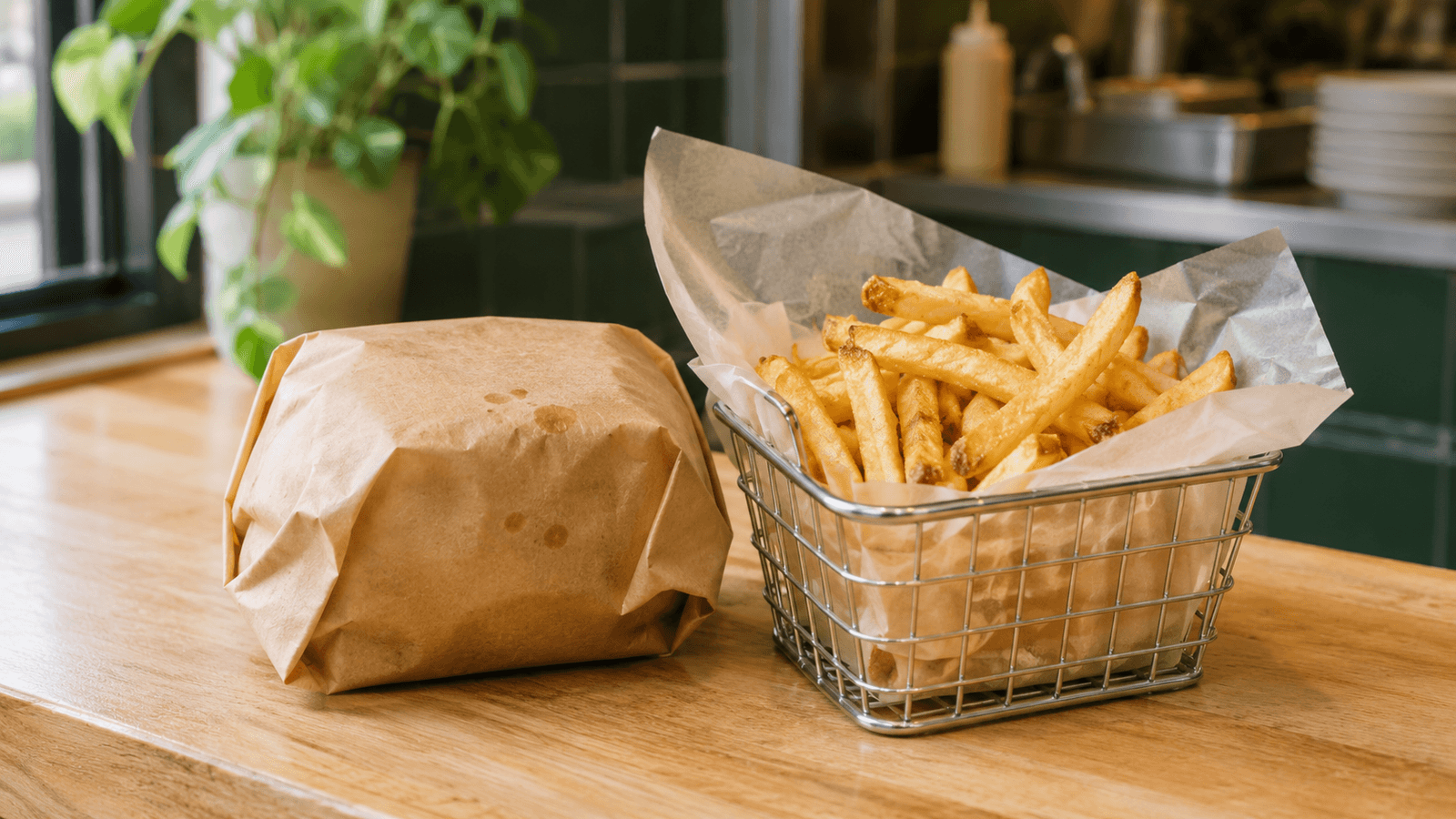
Greaseproof paper is a dense food-contact paper that resists oil because its fibers are refined and pressed so tightly that grease has almost no path through the sheet. It is the light, slightly translucent paper behind burger wraps, basket liners, deli sheets, and bakery tissue.
This guide explains what greaseproof paper is, how it is made, how it differs from parchment and wax paper, what sizes and weights to buy, and which California rules apply to it. It is written for restaurant, cafe, deli, and food truck operators in the Bay Area who buy wraps and liners by the case.
At Safra Distribution we are a family-owned food packaging and restaurant supplies distributor, delivering across six Bay Area counties from our Fremont warehouse. Wraps and liners usually ride in the same order as the brown paper bags and fiber containers they go out with, so this is the primer we would hand a new account.

Greaseproof paper does two jobs on most menus: it wraps the burger and it lines the basket.
Key facts about greaseproof paper
- Greaseproof paper gets its oil resistance from intensive refining of wood pulp, not from a coating, and typical wrap grades run about 30 to 50 gsm.
- US food papers are quoted in pounds on a 24 x 36 inch basis. Multiply by about 1.63 to get gsm, so a 25 lb greaseproof sheet is roughly 41 gsm.
- Grease resistance is rated with the TAPPI T 559 kit test on a scale of 1 to 12; higher is more resistant.
- Since January 1, 2023, California's AB 1200 bans plant-fiber liners and wrappers with intentionally added PFAS or 100 ppm or more total organic fluorine.
- Common US greaseproof paper sheet sizes are 12 x 12, 12 x 15, and 15 x 15 inches, per this burger wrap size guide.
- A 12 x 12 inch grease-resistant kraft wrap in cases of 5,000 listed at about $114 to $155 per case on public wholesale sites in November 2026, or 2 to 3 cents a sheet.
Further reading
What is greaseproof paper?
Greaseproof paper is paper made to hold back fat and oil for a normal service window. The name describes a performance, not a single product, which is why spec sheets also say "grease-resistant," "OGR" (oil and grease resistant), or "deli paper."
True greaseproof paper has no wax, no plastic film, and no silicone layer. The barrier is the sheet itself. That is what separates it from the coated papers it often gets confused with.
The material is older than most people assume. A Norwegian mill developed greaseproof paper in 1894 as a replacement for parchment.
In a Bay Area kitchen, greaseproof paper sits between the food and everything else. Getting it right means fewer soaked bags and fewer double-wrapped burgers.
How is greaseproof paper made?
Greaseproof paper is ordinary papermaking taken to an extreme: the pulp is beaten far longer before it becomes a sheet.

Greaseproof paper looks slightly translucent because the fibers are packed so tightly.
- Pulp. Mills start with chemical wood pulp, usually kraft pulp, because the lignin is gone and the fibers can swell and bond.
- Refining. The pulp is run through refiners far longer than for bag or wrapping paper. The fibers fray, swell, and turn gel-like at the surface.
- Forming and pressing. The refined stock drains slowly on the paper machine, so it runs slower than standard packaging grades.
- Drying and calendering. Steam cylinders dry the sheet and rollers smooth it. A supercalendered version of the same sheet is glassine, the glossy paper used for bakery bags.
- Optional surface treatment. Some mills add starch to even out printability. That is not a wax or silicone coating.
More refining means more energy and a slower machine, which is why greaseproof paper costs more per ton than a standard paper of the same weight.
Greaseproof paper vs parchment paper vs wax paper: what is the difference?
All three look alike in a stack. They behave differently in a kitchen and can go in different bins.

Greaseproof paper, parchment, and wax paper look similar and do different jobs.
Greaseproof paper vs parchment paper. What most US kitchens call parchment is baking paper: a paper base coated with silicone so food releases and the sheet can go in an oven, typically up to about 425 to 445 F. True vegetable parchment is paper passed through a sulfuric acid bath to fuse the fibers, which gives it high wet strength. Greaseproof paper has neither treatment. It is not oven-rated, and it costs less than either kind of parchment.
Greaseproof paper vs wax paper. Wax paper carries paraffin, soy, or other wax in or on the sheet. It holds moisture well and resists grease moderately, but the wax melts under heat. Use it for cold and room-temperature wrapping. Greaseproof paper handles warm, oily food better.
The bin difference. In Alameda County, StopWaste's RE:Source guide says wax paper goes in the green bin in cities like Fremont, Hayward, and Berkeley, while parchment and freezer paper are coated in silicone or plastic and go in the garbage.
The short version: greaseproof paper for hot, greasy food; parchment for baking; wax paper for cold deli work.
Further reading
- Compostable vs biodegradable vs recyclable: California labels
- What to do when there is no composter near you
What is greaseproof paper used for in foodservice?
Greaseproof paper shows up anywhere oil would otherwise soak into a bag, a basket, or a hand. The common formats are:
- Burger and sandwich wraps. Cut sheets folded around the item. The core use on most QSR and counter-service menus.
- Basket liners. Sheets laid in a plastic or wire basket under fries, wings, onion rings, or fried chicken. Liners carry more grease than wraps because the food sits on them.
- Deli and bakery sheets. Interfolded sheets pulled one at a time from a dispenser to pick up pastries, cookies, and cold cuts.
- Bags and pouches. Greaseproof paper bags for cookies, donuts, and fries. See our guide to food-safe kraft paper bags for bag styles.

Greaseproof paper basket liners take the most oil of any wrap format.
Greaseproof paper is less suited to very wet food. Steam and sauce soften greaseproof paper over time, so a saucy burrito on a long delivery run may need a heavier or coated wrap.
For a Bay Area operator the practical split is simple: greaseproof paper next to the food, a paper bag around it, and a fiber container for anything that needs a lid.
Further reading
What size greaseproof paper do you need?
Size greaseproof paper to the food, not to the catalog. A sizing rule used by wrap converters: sheet side equals the item's width, plus twice its height, plus a few inches of fold overlap.

Greaseproof paper sizes side by side, matched to the menu item each one fits.
Common greaseproof paper sizes and what they fit:
- 10 to 12 inch interfolded. Deli counters, pastries, sliders, breakfast muffins. Picked by hand, lighter weight.
- 12 x 12 inch. A single burger, a standard sandwich, or a small basket liner. The most common size.
- 14 x 14 inch. Smash burgers and wider deli sandwiches, where the patty is wide but low.
- 15 x 15 inch. Double and stacked burgers, and the larger basket liner size. Height drives the size more than width.
- 12 x 15 inch rectangle. Subs, hot dogs, wraps, and burritos, rolled and twisted at the ends.
Most menus are covered by two wrap sizes and one liner size. A burger shop might run 12 x 12 greaseproof paper for singles and 15 x 15 for doubles and liners.
Right-sizing saves money: dropping a burger from a 40 cm to a 35 cm greaseproof paper sheet cuts paper per wrap by roughly a quarter.
What do basis weight and kit level mean on a greaseproof paper spec sheet?
Two numbers tell you most of what greaseproof paper will do: weight and kit level. Read them separately.
Basis weight. US food papers are quoted in pounds for 500 sheets of a 24 x 36 inch sheet. A panliner supplier lists its standard greaseproof panliners at 24 lb, or about 38 to 42 gsm. Weight sets stiffness and tear strength, not grease resistance.
Kit level. The TAPPI T 559 kit test drops 12 numbered oil and solvent mixtures on the paper for 15 seconds. The highest number that does not stain is the kit rating. As a starting point:
- Kit 1 to 4. Cookies, pastries, dry baked goods.
- Kit 5 to 8. Burgers and sandwiches with cheese.
- Kit 9 to 12. Fried chicken, fries, and long hold times.

A greaseproof paper kit test: the highest oil mixture that does not stain sets the rating.
One honest caveat. TAPPI designed the kit test for fluorochemical-treated paper and says its use on non-fluorinated papers has to be evaluated. A kit number is useful for comparing two PFAS-free sheets from the same test lab. It is not a promise for your fries. Test with real food at real hold times before you switch a whole menu.
Is greaseproof paper PFAS free in California?
It has to be. California treats greaseproof paper, liners, and wrappers as plant-fiber food packaging, and since January 1, 2023 none of it can be sold here with regulated PFAS.
For decades, many grease-resistant papers relied on fluorinated chemicals. California's Department of Toxic Substances Control noted that plant-fiber food packaging was often treated with PFAS for grease and water resistance, and that PFAS can migrate into food.
AB 1200 defines regulated PFAS two ways:
- Intentionally added. Any PFAS a manufacturer adds that has a functional or technical effect, such as grease resistance.
- Total organic fluorine. PFAS present at 100 ppm or more, measured as total organic fluorine, whether added on purpose or not.
The law names "liners" and "wrappers" in its definition of food packaging, so there is no gray area for greaseproof paper. The state Attorney General's enforcement advisory.pdf) applies the ban to businesses that sell take-out food, not only to manufacturers.
What to ask for: a "no intentionally added PFAS" statement and a total organic fluorine result under 100 ppm, on the exact item you buy.
Further reading
- California plastic labeling laws: SB 343 and AB 1201
- AB 1200 enforcement advisory (California Attorney General).pdf)
Is greaseproof paper compostable, and does it go in the Bay Area green bin?
Usually yes for plain greaseproof paper, because used greaseproof paper is food-soiled paper with no plastic layer. The answer changes with the coating and the city.
Under SB 1383, every California jurisdiction must provide organics collection to businesses, and the state targets 75 percent less organic waste in landfills. Food-soiled paper is part of that stream.
- San Francisco. Recology's what goes where list puts soiled paper and waxed paper in the green compost cart and keeps foil-backed or plastic-backed paper out. SF Environment lists wax paper as compost.
- Alameda County. StopWaste accepts uncoated food-soiled paper, but warns that paper that is shiny, smooth, or appears plastic-lined should stay out. Silicone parchment goes in the garbage in most Alameda County cities.
- Everywhere else. Each hauler sets its own list for greaseproof paper and coated wraps. Check yours first.

Plain greaseproof paper goes in the green bin as food-soiled paper; coated parchment often does not.
If you want to label a wrap "compostable," the claim has to hold up. CalRecycle requires compostable products to have under 100 ppm total organic fluorine, and plastic-coated fiber to meet ASTM D6868. Certified wraps can be looked up in the BPI product database.
Further reading
Quick answers about greaseproof paper
Is greaseproof paper the same as parchment paper?
No. Greaseproof paper has no coating and is not oven-rated. US parchment is silicone-coated baking paper made for oven heat.
Can greaseproof paper go in the oven?
Plain greaseproof paper is not rated for oven use. Use silicone baking paper for sheet pans and keep greaseproof paper for wrapping and lining.
Is greaseproof paper microwave safe?
Some greaseproof paper grades are sold as microwavable, such as this PFAS-free OGR line. Check the sheet for your item before you tell customers to reheat in it.
Is greaseproof paper recyclable?
Once greaseproof paper carries food grease it belongs in the green bin, not the blue one. Recology lists soiled paper as compost.
What does greaseproof paper cost per case?
Greaseproof paper is one of the cheapest items in a takeout order. Public wholesale listings read on November 2, 2026 put common formats here:
- 12 x 12 inch grease-resistant kraft wrap, 5,000 per case: about $114 to $155 per case, or 2 to 3 cents a sheet. Examples: $114.10 and $154.99.
- 10 x 10.75 inch BPI-certified dry wax deli paper, 6,000 per case: about $250 per case, or about 4 cents a sheet.
- 12 x 12 inch printed, silicone-coated, BPI-certified liner, 2,000 per box: about $261 to $272 per box, or 13 to 14 cents a sheet.
Three things move greaseproof paper pricing: print, certification, and sheet size.
Safra Distribution stocks greaseproof wraps and liners and delivers them on weekly routes from Fremont across six Bay Area counties. We do not publish case prices here, because case pricing moves with sheet size, print, and order size; send us what you use today and we will quote your volume.
Can you get custom printed greaseproof paper?
Yes. Printed greaseproof paper is some of the most visible branding on a takeout order, because the customer unwraps it.

Custom printed greaseproof paper usually runs an all-over repeat pattern so every cut sheet shows the brand.
Two print layouts are common:
- Random all-over repeat. The pattern covers the whole sheet, so every cut piece carries the brand wherever the cut lands. The default for wraps.
- Registered print. A logo centered on each sheet. It needs print-to-cut registration and costs more; it earns its place on tray liners.
Plan the art around the fold so the logo lands on top of the wrapped item.
Safra's custom packaging program prints greaseproof wraps and liners, along with bags, cups, napkins, bowls, and catering boxes, with stock held in our Fremont warehouse and released as you need it. You get a print proof and a firm quote before anything goes to production. If you want printed wraps or liners alongside your bags, put them in the same request.
How do you choose a greaseproof paper?
A good greaseproof paper buy comes down to six checks. Run them before you order a pallet.
- PFAS statement. "No intentionally added PFAS" and a total organic fluorine result under 100 ppm for the exact item.
- Coating. Plain greaseproof, dry wax, or silicone. It decides the oven rating and which bin it goes in.
- Kit level. Match the rating to your greasiest item and its hold time, then test with real food.
- Basis weight. Heavier for basket liners and wet fillings, lighter for interfolded deli sheets.
- Sheet size. Two wrap sizes and one liner size cover most menus.
- Hauler acceptance. Confirm your city takes it in the green bin before you call it compostable.
Most operators end up with three greaseproof paper items: one 12 x 12 wrap, one larger sheet for doubles and liners, and an interfolded deli sheet if they run a counter. Add printed wraps once the plain ones are dialed in.
Final thoughts
Greaseproof paper is a small line on the invoice and a big part of how takeout feels. A greaseproof paper wrap that holds its fold and a liner that does not soak through are what customers notice.
If you are re-quoting, start with the wrap you use most. Get the PFAS statement, check the kit level against your greasiest item, and confirm your hauler takes it. Then price it by the case with the rest of your order.
Questions about a specific greaseproof paper, sheet size, or a printed wrap for several locations? Send us what you use today and we will match it line by line.
Further reading
Related posts
 Paper Bags
Food-Safe Kraft Paper Bags: Wholesale Foodservice Bags
Food safe paper bags for kitchens: FDA paper rules, PFAS-free grease barriers, Bay Area bag laws, and how to buy kraft paper bags wholesale.
Safra12 min read Paper Bags
How to Choose Brown Paper Bags for Your Business: Sizes, Weights and Bulk Pricing
Choose brown paper bags by size, basis weight, and bulk case pricing for Bay Area takeout, bakery, and checkout programs.
Safra14 min read Paper Bags
California Paper Bag Law: What Changed in 2026 and What Comes in 2028
SB 1053 ended plastic checkout bags in California. Here is what stores must do now and before the 2028 recycled content deadline.
Safra4 min read